
Pre-Event Psychosocial Risk Management:
A Comprehensive Framework for Early Intervention

Abstract
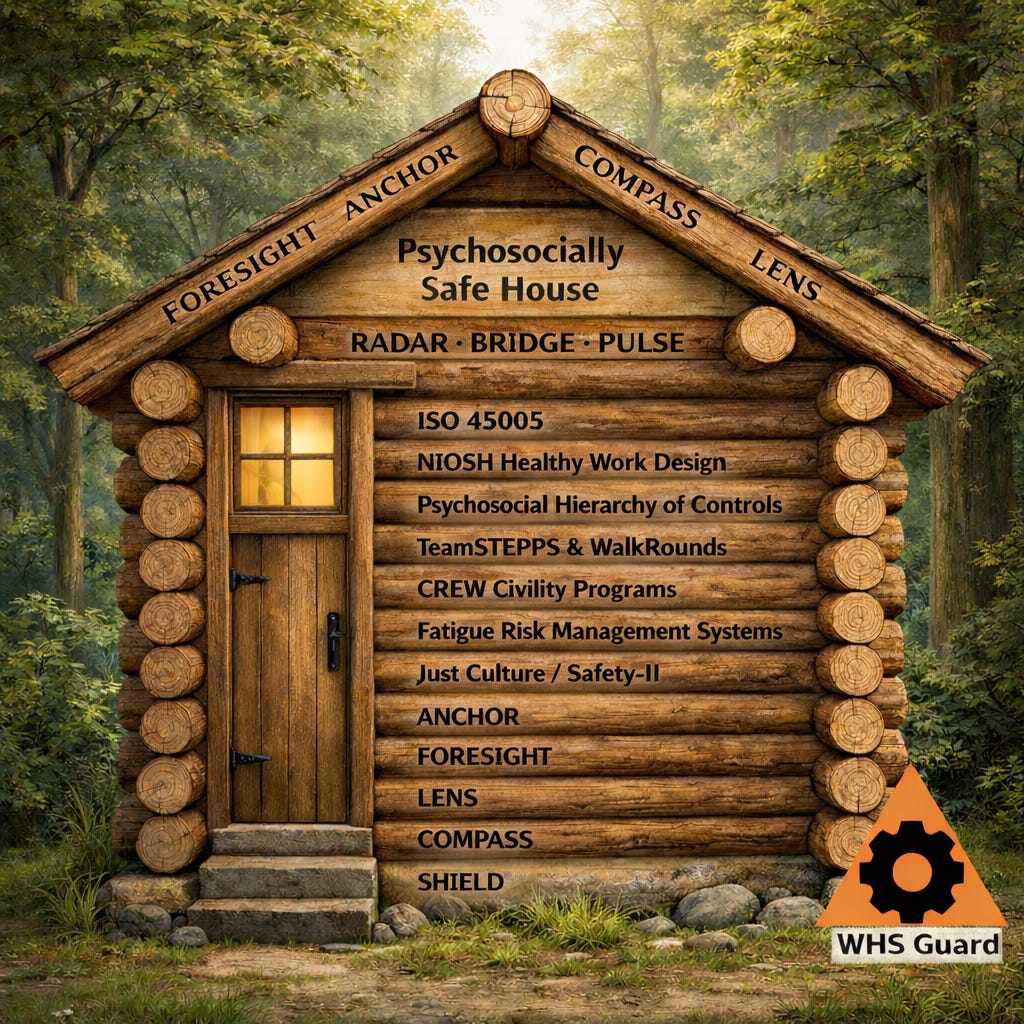
Psychosocial risks are increasingly recognised as significant contributors to work-related harm, with mental health claims now outpacing physical injury claims in both cost and duration. Traditional reliance on reactive and tertiary interventions such as Employee Assistance Programs (EAPs) has proven insufficient, as these measures address consequences rather than root causes. This paper proposes a comprehensive suite of pre-event (primary) interventions designed to prevent psychosocial harm before it occurs. Building on the five-pillar model—RADAR (proactive risk identification), BRIDGE (building psychological safety), PULSE (early warning systems), CARE (support with limited resources), and LEAD (leadership under pressure)—the framework is expanded through integration of evidence-based mechanisms from international research and the development of new tools including ANCHOR, FORESIGHT, LENS, COMPASS, and SHIELD. Case studies from Victoria Police, NHS England, and NASA illustrate operationalisation. The paper concludes with implications for governance, ethical considerations, measurement traps, and directions for future research.
1. Introduction
Psychosocial hazards, defined in the Australian Work Health and Safety (WHS) Codes of Practice as risks arising from the design, organisation, and management of work, are now central to regulatory and organisational agendas (Safe Work Australia, 2022). Data from Safe Work Australia show that mental health condition claims are significantly more costly than physical injury claims, averaging AUD $58,615 compared to AUD $15,743, and result in longer median time lost (34.2 weeks versus 8 weeks) (Safe Work Australia, 2022). This places psychosocial risk management at the forefront of compliance, governance, and operational resilience.
Historically, organisations have defaulted to reactive measures such as counselling or EAPs. These interventions are important but insufficient, as they fail to address the systemic drivers of harm (Dollard & Bakker, 2010). Increasingly, regulators and standards bodies emphasise pre-event or primary controls—interventions that eliminate or reduce hazards at their source before harm occurs (ISO, 2021).
This paper builds on a five-pillar model of pre-event controls—RADAR, BRIDGE, PULSE, CARE, and LEAD—by integrating additional evidence-based mechanisms and proposing new tools that address gaps in predictive modelling, cultural alignment, and leadership accountability.
2. Literature Review
Edmondson (1999) first conceptualised psychological safety as a belief that one can speak up without risk of punishment, linking it to learning behaviours and team performance. Her later work, The Fearless Organization (2019), positioned psychological safety as a foundation for innovation and growth. These insights underpin BRIDGE interventions that cultivate trust and openness.
Dollard and Bakker (2010) introduced the Psychosocial Safety Climate (PSC) construct, framing organisational climate as a “cause of the causes” that predicts psychosocial risks. Zadow et al. (2017) demonstrated that PSC predicts emotional exhaustion, work injuries, and turnover intentions, making it one of the strongest leading indicators for psychosocial harm.
Internationally, ISO 45003:2021 provides the first global standard for managing psychosocial risks, requiring proactive hazard identification, consultation, and continual improvement (ISO, 2021). Complementary programs such as NIOSH’s Healthy Work Design and Wellbeing initiative (NIOSH, 2020) emphasise redesign of work systems to reduce psychosocial hazards.
The Psychosocial Hierarchy of Controls (P-HoC) (Loh et al., 2025) adapts the traditional hierarchy of controls to prioritise hazard elimination and substitution over administrative or individual-level solutions. Similarly, interventions such as TeamSTEPPS (Agency for Healthcare Research and Quality [AHRQ], 2017), CREW civility programs (Osatuke et al., 2013), and Schwartz Rounds (Maben et al., 2018) offer structured mechanisms for improving communication, civility, and collective processing of emotional stress.
Emerging innovations include fatigue risk management systems (FRMS) (Dawson et al., 2017), predictive analytics for early warning of psychosocial hazards (Wu et al., 2023), and “Just Culture” frameworks that balance accountability with learning (Dekker, 2012). Together, these approaches extend the possibilities for proactive psychosocial risk management.
3. Frameworks for Pre-Event Controls
RADAR: Proactive risk identification through scanning, work design analysis, and hazard mapping.
BRIDGE: Building psychological safety by fostering trust, open communication, and civility.
PULSE: Developing early warning dashboards and indicators that provide real-time signals of risk.
CARE: Supporting with limited resources by leveraging high-yield, low-cost interventions.
LEAD: Strengthening leadership capacity under pressure and embedding psychosocial safety in governance.
ISO 45003 Control Families: Embedding psychosocial risk into policies, consultation, and performance monitoring (ISO, 2021).
NIOSH Healthy Work Design: Redesigning work tasks, schedules, and autonomy to prevent harm (NIOSH, 2020).
Psychosocial Hierarchy of Controls (P-HoC): Prioritising elimination/substitution of hazards (Loh et al., 2025).
TeamSTEPPS and WalkRounds: Structured communication and executive visibility (AHRQ, 2017).
CREW Civility Programs: Reducing workplace incivility and improving engagement (Osatuke et al., 2013).
Schwartz Rounds: Providing collective forums for staff to process emotional challenges (Maben et al., 2018).
Fatigue Risk Management Systems: Monitoring and controlling workload and recovery windows (Dawson et al., 2017).
Just Culture / Safety-II: Encouraging reporting and learning from what goes right (Dekker, 2012).
ANCHOR: Aligning norms, culture, habits, and organisational rules to close the gap between policy and practice.
FORESIGHT: Applying predictive modelling and scenario planning to anticipate psychosocial risks.
LENS: Using leadership network analysis to identify hidden influencers and mid-level leadership stress.
COMPASS: Mapping psychosocial risks across sites or units to produce live heatmaps.
SHIELD: Embedding structured psychosocial hazard reviews at critical decision gates.
4. Case Studies
4.1 Victoria Police
Application of PSC-12 revealed that units with low PSC scores had three times higher injury rates. Pre-event controls included annual PSC surveys, leadership KPIs linked to climate improvement, peer-support networks, and transparent reporting of survey actions (Dollard et al., 2021).
4.2 NHS England
The NHS Health and Wellbeing Framework embedded wellbeing metrics in board governance. Trust boards reviewed dashboards quarterly and appointed Wellbeing Guardians to ensure accountability. Preventive interventions included rostering protections, rest facilities, and wellbeing check-ins (NHS England, 2023).
4.3 NASA
For long-duration space missions, NASA implemented psychosocial screening, resilience training, scheduled psychological check-ins, and environmental design features such as private space and crew autonomy. These interventions normalised psychosocial safety as mission-critical (NASA, 2015).
4.4 CREW and Schwartz Rounds
CREW programs reduced incivility and improved climate in healthcare and government agencies (Osatuke et al., 2013). Schwartz Rounds allowed staff to process emotional stress collectively, improving wellbeing and reducing turnover intention (Maben et al., 2018).
5. Implementation Strategy
Effective implementation requires integration into existing WHS governance systems. Key actions include:
Embedding psychosocial risks into organisational risk registers;
Prioritising controls by the P-HoC;
Quarterly reporting to boards on PSC thresholds, early-warning indicators, and control distribution;
Applying SHIELD reviews at all project and change decision gates;
Using COMPASS dashboards to monitor hotspots;
Conducting ANCHOR audits to align culture with policy;
Deploying FORESIGHT analytics for predictive monitoring.
6. Discussion
Why pre-event controls matter: Case studies confirm that proactive measures—PSC tracking in policing, governance frameworks in healthcare, and structured psychosocial readiness in space missions—reduce harm and improve resilience.
Governance implications: Officers under WHS Act s.27 are obligated to ensure psychosocial hazards are controlled with adequate resources and processes. Reporting should include PSC heatmaps, early warning indicators, and evidence of control prioritisation at higher tiers of the P-HoC.
Measurement traps: Over-reliance on annual surveys risks missing emerging issues. Dashboards must combine leading indicators such as overtime, absenteeism, turnover, and “safe to speak up” scores with climate data.
Ethical considerations: Dashboards risk drifting into surveillance. Aggregated data, minimum n-sizes, and consultation with worker representatives mitigate this. Transparency—“you said, we did”—is essential for trust.
Resource triage: In constrained environments, organisations should prioritise high-yield, low-cost interventions such as CREW civility cycles, Schwartz Rounds, and TeamSTEPPS micro-drills.
Sector nuances:
Policing: PSC and fatigue controls are critical.
Healthcare: Schwartz Rounds and WalkRounds are effective.
Knowledge work: Protecting autonomy and voice is essential.
Future research: Comparative effectiveness of P-HoC tiers, cost-benefit of Schwartz Rounds and CREW outside healthcare, predictive value of FORESIGHT analytics, and integration of COMPASS dashboards into enterprise risk systems.
7. Conclusion
Pre-event psychosocial risk management is no longer optional—it is a regulatory, ethical, and operational necessity. A comprehensive framework of fifteen tools now provides multiple entry points for organisations: from RADAR scanning to SHIELD decision gates, from BRIDGE culture building to FORESIGHT predictive modelling. Embedding these tools into governance systems, resourcing them adequately, and monitoring effectiveness with leading indicators offers the strongest pathway to preventing psychosocial harm before it occurs.
References
Agency for Healthcare Research and Quality. (2017). TeamSTEPPS 2.0: Strategies and tools to enhance performance and patient safety. AHRQ. https://www.ahrq.gov/teamstepps/index.html
Dekker, S. (2012). Just culture: Balancing safety and accountability (2nd ed.). Ashgate.
Dawson, D., Chapman, J., & Thomas, M. J. W. (2017). Fatigue-proofing: A new approach to reducing fatigue-related risk using the principles of error management. Sleep Medicine Reviews, 33, 9–18. https://doi.org/10.1016/j.smrv.2016.04.003
Dollard, M. F., & Bakker, A. B. (2010). Psychosocial safety climate as a precursor to conducive work environments, psychological health problems, and employee engagement. British Journal of Management, 21(2), 541–555. https://doi.org/10.1111/j.1467-8551.2009.00600.x
Edmondson, A. (1999). Psychological safety and learning behavior in work teams. Administrative Science Quarterly, 44(2), 350–383. https://doi.org/10.2307/2666999
Edmondson, A. (2019). The fearless organization: Creating psychological safety in the workplace for learning, innovation, and growth. Wiley.
ISO. (2021). ISO 45003: Occupational health and safety management — Psychological health and safety at work — Guidelines for managing psychosocial risks. International Organization for Standardization.
Loh, M. Y., Zadow, A. J., Dollard, M. F., & Tuckey, M. R. (2025). The Psychosocial Hierarchy of Controls: Preventing harm by design. Safety Science, 168, 106959. https://doi.org/10.1016/j.ssci.2023.106959
Maben, J., Taylor, C., Dawson, J., Leamy, M., McCarthy, I., Reynolds, E., … & Bridges, J. (2018). A realist informed mixed-methods evaluation of Schwartz Center Rounds® in England. Health Services and Delivery Research, 6(37). https://doi.org/10.3310/hsdr06370
NASA. (2015). Psychosocial support for long-duration space missions. NASA Technical Reports. https://ntrs.nasa.gov/citations/20150002965
NIOSH. (2020). Healthy Work Design and Well-Being. National Institute for Occupational Safety and Health. https://www.cdc.gov/niosh/programs/hwd/
NHS England. (2023). NHS health and wellbeing framework. NHS England. https://www.england.nhs.uk/long-read/nhs-health-and-wellbeing-framework/
Osatuke, K., Moore, S. C., Ward, C., Dyrenforth, S. R., & Belton, L. (2013). Civility, Respect, Engagement in the Workforce (CREW): Nationwide organization development intervention at Veterans Health Administration. Journal of Applied Behavioral Science, 49(3), 279–302. https://doi.org/10.1177/0021886312471395
Safe Work Australia. (2022). Psychosocial hazards and risks in the workplace: Code of practice. Safe Work Australia. https://www.safeworkaustralia.gov.au/doc/model-code-practice-managing-psychosocial-hazards-work
Wu, G., Zhao, X., & Xie, X. (2023). Predictive modelling of psychosocial risks at work using big data analytics. Frontiers in Public Health, 11, 112344. https://doi.org/10.3389/fpubh.2023.112344
Zadow, A. J., Dollard, M. F., Parker, L., Storey, K., & Winefield, A. H. (2017). Psychosocial safety climate, emotional exhaustion, and work injuries: Testing a multilevel mediation model. Safety Science, 96, 132–141. https://doi.org/10.1016/j.ssci.2017.03.001