
NIOSH Healthy Work Design and Well‑Being Program
Pre-Event Psychosocial Risk Management Framework 7

Introduction
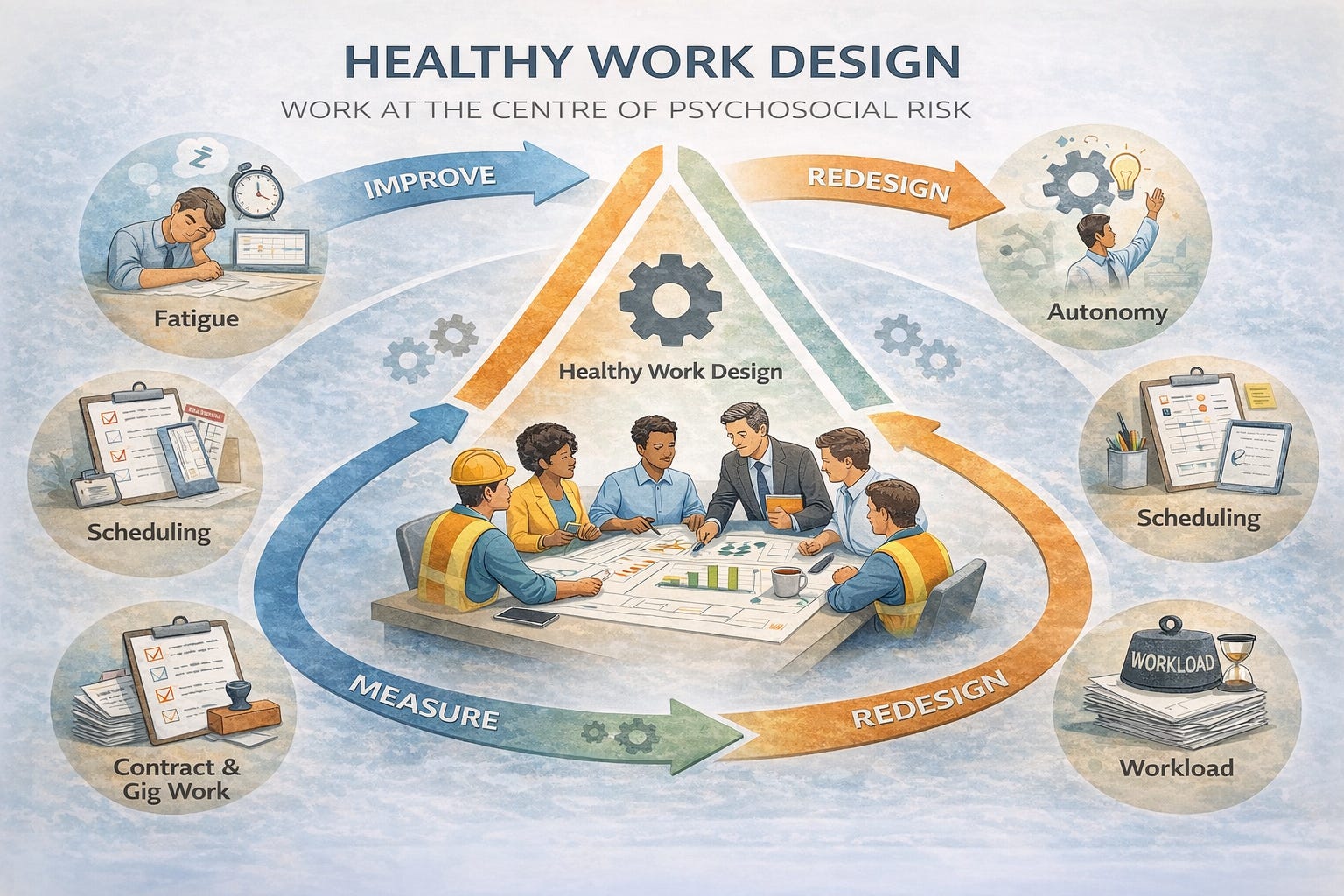
The National Institute for Occupational Safety and Health (NIOSH) launched the Healthy Work Design and Well‑Being (HWD) Program to improve the design of work, work environments, management practices and organisational policies. Unlike traditional occupational safety programmes that focus primarily on physical hazards, the HWD Program takes a holistic view of how jobs, schedules and organisational structures affect worker health. Its mission is to help workers thrive and contribute productively by addressing the physical and psychosocial work environment, particularly issues such as working hours, fatigue, non‑standard work arrangements and occupational stress. This aligns with global trends, including the move towards psychosocial risk management embodied in ISO 45003.
Program goals and priorities
The HWD Program works with industry, labour, trade associations and researchers to tackle core priorities:
· Improve the organisation of work to reduce job stress and enhance health. NIOSH emphasises exploring how job design and external factors (societal, technological, regulatory) influence work organisation and health. Priority areas include reducing excessive workloads, clarifying roles and increasing worker autonomy.
· Address non‑standard work arrangements. Temporary, contract and gig work create unique risks because workers often lack control over schedules and job security. The program seeks to advance safety and health for these workers.
· Protect workers from shift work, long schedules and fatigue. Research aims to understand the health effects of long hours and irregular schedules and to identify cost‑effective interventions to mitigate fatigue.
How the program works
Research and surveillance
NIOSH scientists explore the safety and health effects of work organisation by studying how workloads, schedules and management practices affect stress, health and quality of life[5]. They also examine economic factors that influence worker safety and well‑being[6]. To monitor trends, the program designs surveys (such as the publicly available Worker Well‑Being Questionnaire) that track changes in work organisation and the resulting effects on health[7][8].
Identifying interventions
Research efforts include studying associations between work arrangements and stress and identifying cost‑effective interventions that organisations can use to reduce negative impacts[9]. These interventions often target work design, scheduling, job control and supportive management. The program promotes evidence‑based approaches such as Total Worker Health®, which emphasises organisational‑level solutions before individual‑level interventions.
Translation and outreach
The HWD Program disseminates findings through blogs, fact sheets and conferences. Recent achievements include releasing the Worker Well‑Being Questionnaire (WellBQ), presenting a framework for healthy work design at an international conference and publishing guidance during the COVID‑19 pandemic. It also launched the Workplace Supported Recovery website, providing evidence‑based policies and programs to prevent substance use disorders and support recovery. Future plans involve developing more comprehensive workplace solutions and continuing national survey modules.
Key principles of Healthy Work Design
1 Design work to reduce stress and increase control
Healthy work design starts with understanding how jobs and work arrangements create psychosocial hazards. Excessive job demands, unpredictable schedules and lack of autonomy can lead to chronic stress. The HWD Program encourages organisations to redesign roles to provide clarity and flexibility and to involve workers in decision‑making. Surveys and consultation help identify stressors and opportunities for improvement.
2 Address non‑standard work arrangements
Temporary and gig workers often experience insecure employment, variable pay and isolation. NIOSH promotes policies that extend safety and health protections to these workers, including clear contracts, fair scheduling and access to benefits. Research also explores how non‑standard arrangements contribute to psychosocial risks and what interventions can mitigate them[4].
3 Manage working hours and fatigue
Long shifts, night work and insufficient rest are associated with errors, injuries and chronic health problems. HWD research seeks to identify scheduling practices that reduce fatigue and to evaluate interventions such as shift rotation, mandatory rest periods and fatigue training. Employers are encouraged to monitor working hours and implement fatigue risk management systems.
4 Use organisational‑level interventions first
Drawing on the Total Worker Health framework, the HWD Program emphasises that employers should start with interventions targeting working conditions and organisational‑level solutions before turning to individual‑level interventions. For example, adjusting workloads or providing autonomy and support is more effective than solely offering resilience training. This approach aligns with the hierarchy of controls, prioritising changes to the work environment over personal coping strategies.
5 Promote continuous improvement
Healthy work design is an ongoing process. Organisations are urged to conduct surveillance, evaluate the impact of interventions and adjust strategies. The HWD Program contributes by designing and administering national surveys, such as the Quality of Work Life Survey modules, to track trends and inform policy.
Practical examples and case studies
While the HWD Program sets research priorities, practical implementation occurs in workplaces that redesign jobs and work environments.
Example: Flexible scheduling in retail
A retail chain piloted predictable scheduling and increased staffing during busy periods. By investing roughly USD 31,200 across 28 stores, the initiative led to a 5 % productivity increase and 7 % sales increase as well as improved sleep and well‑being. The case illustrates how adjusting work organisation—a core principle of healthy work design—can benefit both workers and businesses.
Example: Peer support and recovery programs
The Johns Hopkins RISE program provides 24/7 peer support for health workers after stressful events. The program shares emotional support duties across a broad network and trains leaders, breaking the cycle of burnout and strengthening resilience. This shows how addressing support and management practices can reduce psychosocial harm.
Example: Micro‑breaks and short rest periods
Research on micro‑breaks shows that short breaks of up to 10 minutes can boost vigour and reduce fatigue and that such breaks are beneficial for well‑being and performance. Encouraging micro‑breaks is a simple, low‑cost intervention consistent with healthy work design.
Integration with broader frameworks
Healthy work design supports and complements other psychosocial risk frameworks such as ISO 45003 and the psychosocial hierarchy of controls. By focusing on eliminating hazards at the source—through better job design, fair scheduling and supportive management—HWD addresses upstream determinants of stress. The program’s emphasis on surveillance, research and translation fosters evidence‑based interventions that organisations can integrate into their occupational health and safety management systems.
Conclusion
The NIOSH Healthy Work Design and Well‑Being Program recognises that the design of work itself is a fundamental determinant of worker health. By improving work organisation, addressing non‑standard arrangements, managing working hours and promoting organisational‑level solutions, the program aims to prevent psychosocial harm and enhance well‑being. Its research priorities and activities—ranging from survey development to intervention studies—provide practical guidance for employers, while achievements such as the Worker Well‑Being Questionnaire and workplace recovery resources demonstrate a commitment to translation and impact. As psychosocial hazards become more prominent, adopting healthy work design principles will be essential for organisations seeking to fulfil their legal duties, support employees and build sustainable businesses.
References
· National Institute for Occupational Safety and Health. (2020). Healthy Work Design and Well‑Being Program. The HWD program works with partners to improve the organisation of work, protect workers in non‑standard arrangements and reduce fatigue.
· National Institute for Occupational Safety and Health. (2024). Healthy Work Design and Well‑Being Program (research program page). The program aims to improve work design, management practices and the physical and psychosocial work environment and focuses on working hours, non‑standard work arrangements and occupational stress.
· NIOSH. (2020). Healthy Work Design and Well‑Being Program fact sheet. The program explores the health effects of work organisation, designs surveys, researches work arrangements and identifies cost‑effective interventions. It has released the Worker Well‑Being Questionnaire and the Workplace Supported Recovery website.
· NIOSH Total Worker Health. (2024). Total Worker Health® in Action! newsletter. It highlights that psychosocial hazards are rising and that employers should use the hierarchy of controls, focusing on organisational interventions before individual measures, and recommends increasing awareness, research, surveillance and standards.
· Practical interventions and case studies: micro‑break research shows breaks boost vigour and reduce fatigue; the Johns Hopkins RISE program demonstrates peer support effectiveness; and a retail scheduling initiative improved productivity and well‑being.
Healthy Work Design and Well-Being Program | NIOSH Research Programs | CDC
https://www.cdc.gov/niosh/research-programs/portfolio/hwd.html
cdc_111482_DS1.pdf
https://stacks.cdc.gov/view/cdc/111482/cdc_111482_DS1.pdf
Total Worker Health® in Action! June 2024 | Total Worker Health | CDC
https://www.cdc.gov/niosh/twh/news/june2024.html
Workplace Well‑Being Resources | HHS.gov
The RISE (Resilience in Stressful Events) Peer Support Program: Creating a Virtuous Cycle of Healthcare Leadership Support for Staff Resilience and Well-Being - PMC
https://pmc.ncbi.nlm.nih.gov/articles/PMC11639878/
“Give me a break!” A systematic review and meta-analysis on the efficacy of micro-breaks for increasing well-being and performance - PMC