
ISO 45003 Controls: A Blueprint for Psychosocial Risk Management
Pre-Event Psychosocial Risk Management Framework 6

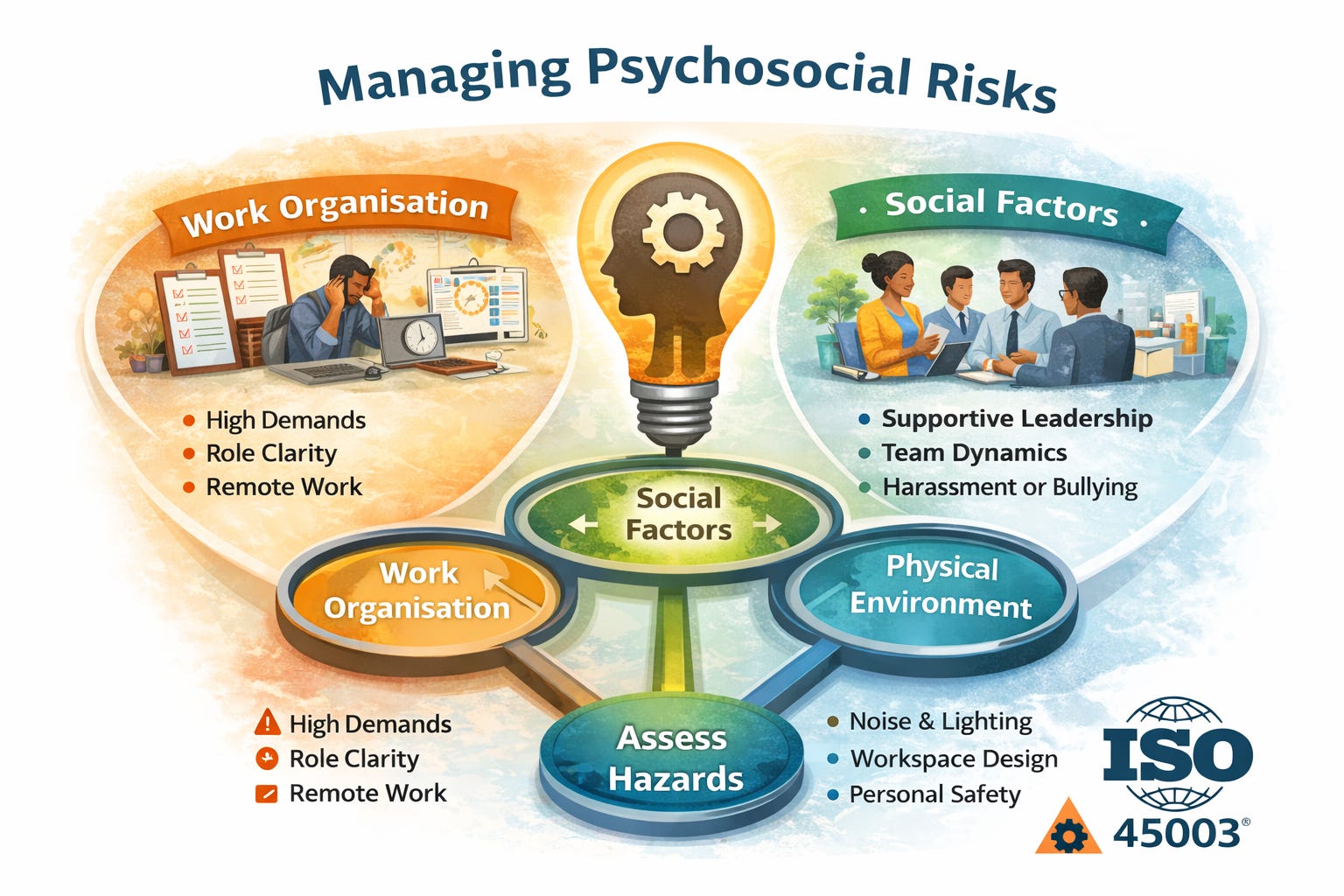
ISO 45003 control families and psychosocial risk management
Introduction
ISO 45003:2021 is the first global standard to give specific guidance for managing psychosocial risks within an occupational health and safety management system. The standard recognises that psychological health is as important as physical safety and that psychosocial hazards can have serious organisational impacts such as burnout, workplace conflict and turnover. Effective management of these hazards improves engagement, productivity, innovation and sustainability. The standard follows the Annex SL structure (context, leadership and worker participation, planning, support, operation, performance evaluation and improvement), but at its core it identifies three families of psychosocial hazards and corresponding control measures: aspects of how work is organised, social factors in the workplace, and the work environment/equipment and hazardous tasks. This article explains these control families, shows how they align with due‑diligence duties under Australia’s Work Health and Safety (WHS) legislation and provides case studies illustrating practical control measures.
1 Control families under ISO 45003
1.1 Aspects of how work is organised
This category covers job design and organisational practices that affect mental load and control. ISO 45003 lists common hazards such as role ambiguity, lack of job control/autonomy, excessive demands, poorly managed organisational change, poorly designed remote or hybrid work, and issues with workload and work pace, working hours and job security. These hazards arise when employees are unclear about expectations, have little influence over their tasks, work under high time pressure or face insecure work.
Controls should aim to eliminate or reduce these hazards at their source, consistent with the psychosocial hierarchy of controls. Effective controls include:
· Clarifying roles and expectations through up‑to‑date job descriptions, induction and ongoing communication.
· Providing task autonomy and flexible work arrangements where possible.
· Balancing workload and pace by scheduling work evenly, adding staff during peak periods and redesigning tasks to reduce time pressure.
· Managing organisational change with clear communication, worker consultation and adequate support.
· Job security and rostering: providing predictable contracts, fair roster systems and limiting long working hours.
1.2 Social factors at work
This family includes interpersonal relationships, leadership style, organisational culture, recognition and reward, career development, support, supervision, respect/civility, work–life balance and exposure to violence, bullying or harassment[3]. A hostile social environment is a significant predictor of burnout and turnover.
Controls emphasise leadership commitment, fair policies and positive culture:
· Inclusive leadership and organisational justice: training leaders in empathy and consultation, ensuring fair decision‑making and clear grievance processes.
· Recognition and reward: acknowledging contributions and providing career development opportunities.
· Support and supervision: ensuring employees have adequate supervision and peer support mechanisms, particularly after critical incidents or vicarious trauma.
· Respect and civility: implementing civility and diversity programs and zero‑tolerance policies for bullying or harassment.
· Work–life balance: providing flexibility and job sharing.
1.3 Work environment, equipment and hazardous tasks
This category addresses hazards arising from the physical environment, equipment and tasks. ISO 45003 identifies issues such as inadequate equipment, poor workplace conditions (noise, heat, lighting), extreme or unstable environments and hazardous tasks that cause psychological strain. While these hazards are often considered physical, they have psychosocial dimensions when they make employees feel unsafe or unsupported.
Controls include:
· Ensuring equipment adequacy: providing fit‑for‑purpose tools and equipment and maintaining them.
· Improving physical conditions: controlling noise, heat and ventilation, providing adequate lighting and rest areas.
· Designing hazardous tasks: rotating tasks to reduce monotony or exposure to traumatic events and providing additional supervision or peer support.
2 Implementing ISO 45003: risk management process
2.1 Hazard identification and risk assessment
ISO 45003 requires organisations to identify and assess psychosocial hazards in consultation with workers. The Western Australian Code of Practice for psychosocial hazards provides practical guidance: involve management, workers and subject‑matter experts; gather data from incident reports, complaints, absenteeism rates, turnover and surveys; review organisational structure and job requirements; inspect the physical environment; examine HR data such as leave usage and exit interviews; and consult relevant codes and literature. Assessments should consider who may be exposed, the sources of risk, the likelihood and severity of harm, interactions between hazards and whether existing controls are effective[6]. Because multiple factors interact (e.g., high workload combined with low control and poor support), hazards should not be assessed in isolation.
2.2 Hierarchy of controls
The WHS hierarchy of controls applies to psychosocial risks. Eliminating the hazard (e.g., removing excessive overtime) is most effective, followed by substitution (e.g., replacing traumatic tasks with less distressing alternatives), engineering or organisational controls (e.g., workload reallocation), administrative controls (e.g., training, policies) and personal protective equipment (the least effective for psychosocial hazards)[8]. ISO 45003 emphasises the need to prioritise elimination and minimise reliance on lower‑tier controls. Monitoring and review processes should be in place to identify early trends and trigger corrective action, including scheduled discussions, reviewing incident and grievance reports, and using early detection mechanisms (hazard reports, complaints, surveys, consultation, observations)[9].
2.3 Integration into management systems
Riskonnect suggests aligning existing risk management systems with ISO 45003 by identifying and tracking psychosocial hazards, implementing controls and policies, adjusting risk assessments, capturing incidents and near misses, and treating psychosocial risks with the same rigour as physical risks. Organisations should document evidence of compliance, integrate psychosocial risk management into their health, safety and wellbeing strategies and continuously monitor effectiveness.
3 Case studies: applying control families
3.1 Hairdressing salon (small business)
A small hairdressing salon faced risk factors such as fast pace, repetitive tasks, inadequate support, low recognition, adverse environmental conditions (noise, chemical odours) and inappropriate behaviour from customers. Controls aligned with the three families:
· Work organisation: adjusting workloads to avoid excessive pace, providing variety by rotating tasks and ensuring clear job descriptions.
· Social factors: fostering an inclusive environment, training staff to handle customer behaviour, providing supervision and recognition and encouraging breaks and debriefing.
· Work environment: improving ventilation and noise reduction, providing suitable PPE and clear policies regarding chemical handling.
These controls, implemented through consultation and training, reduced turnover and improved morale.
3.2 Medical centre (medium‑sized practice)
In a medium medical centre, staff experienced fast pace, time pressure, excessive workload, burnout, vicarious trauma (exposure to patient suffering) and inappropriate behaviour. Controls included:
· Work organisation: scheduling appointments with buffer periods, introducing rosters with manageable workloads, limiting hours and providing fatigue management and leave.
· Social factors: offering training on burnout, destigmatising mental health and providing confidential peer support and debriefing.
· Work environment: implementing a case allocation system to share emotionally demanding cases and developing clear policies against inappropriate behaviour.
These measures improved psychological safety, reduced burnout and increased staff retention.
3.3 Automotive workshop (industrial setting)
A medium automotive workshop reported poor leadership and communication, inadequate policies, lack of role clarity and high noise and heat exposure. Controls were implemented across the families:
· Work organisation: establishing consultative leadership practices, updating job descriptions and clear processes, and providing toolbox meetings and supervision.
· Social factors: improving organisational justice with consistent policies, creating safe procedures for raising concerns and fostering inclusive culture.
· Work environment: reducing noise and heat, improving ventilation, providing suitable PPE and ensuring easy access to policies and procedures.
The workshop observed lower injury rates and improved team cooperation.
3.4 State government department (large organisation)
This large department suffered from poor leadership, high workloads, poor change management, inappropriate behaviour, inadequate support and recognition[. Controls included:
· Work organisation: implementing a mental‑health strategy, improving planning and workload management, using structured change management approaches and setting more realistic KPIs.
· Social factors: training leaders on psychological safety and diversity, establishing fair policies, and providing coaching and mentoring.
· Work environment: implementing flexible working options, providing adequate resources and support, and developing recognition programs.
These interventions improved engagement and reduced psychosocial hazards.
4 Conclusion
ISO 45003’s control families provide a comprehensive framework for organisations to manage psychosocial risks proactively. By categorising hazards into work organisation, social factors and work environment, the standard helps leaders identify and prioritise controls. Real‑world examples demonstrate that practical measures—such as balanced workloads, inclusive leadership, supportive policies and improved physical conditions—can reduce psychosocial hazards and enhance wellbeing. Integrating these controls into existing WHS and risk management systems, prioritising elimination and substitution, and continuously monitoring and reviewing hazards enable organisations to meet their legal duties, build resilient workplaces and foster a culture where psychological health is as valued as physical safety.
Reference
s:
iso_45003_tech_report_final_210703.pdf
Psychosocial Hazards Based on ISO 45003 | NASP
https://www.naspweb.com/blog/psychosocial-hazards/
Psychosocial hazards in the workplace - code of practice
https://www.worksafe.wa.gov.au/sites/default/files/atoms/files/221154_cp_psychosocialhazards.pdf
Managing Psychosocial Hazards: Aligning Processes with ISO 45003 to Meet Mandatory Regulations · Riskonnect