
WHS Guard: Organizational Behavior Risk Scan

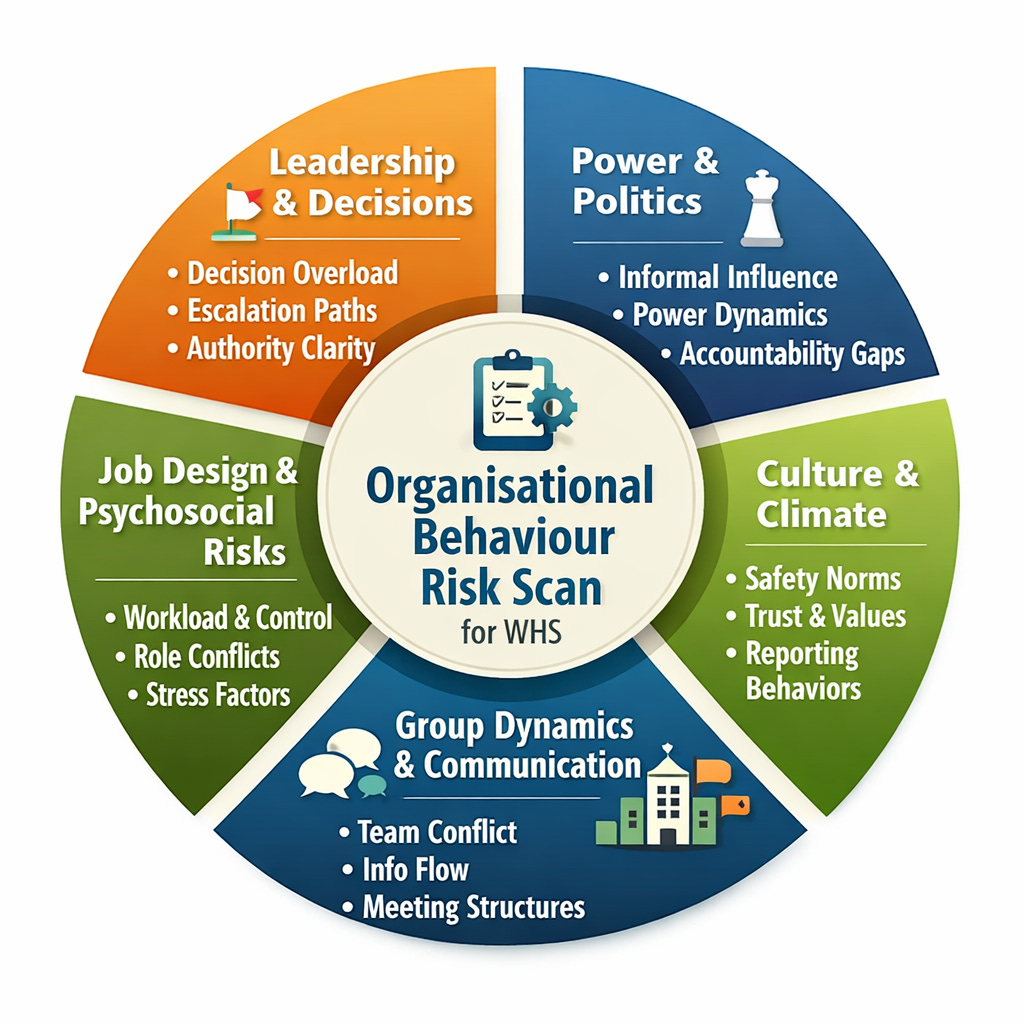
This one‑page scan translates organisational behaviour theory into a practical diagnostic tool for WHS audits and early engagement sessions. It focuses on how leadership, power dynamics, work design, culture and group processes influence psychosocial hazards and due diligence obligations. Use it to observe workplaces, frame interviews and workshops, and structure reports. Align the scan with ISO 45001/45003 and Australian due‑diligence requirements: psychosocial risks such as excessive workload, poor role clarity, low autonomy, inadequate leadership support, bullying or exclusion, job insecurity and isolation are recognised hazards. An effective audit assesses how these hazards are identified, assessed, controlled, and reviewed.
How to use this scan
1. Observe and ask: Use the domains below as lenses while touring the workplace, reviewing documents and interviewing leaders and workers. Focus on how decisions are made, who holds power, how work is designed, how people interact, and how information flows.
2. Map findings to psychosocial hazards: Identify which aspects of work create risks such as high demand, role conflict, low autonomy, lack of support, bullying, unfair treatment or isolation.
3. Assess controls and governance: Check whether psychosocial risks are incorporated into policy and leadership training, whether workers are consulted, hazards documented, risks assessed, controls proportionate, and monitoring continual.
4. Report and recommend: Translate findings into WHS governance language. Recommend system‑level controls: role redesign, workload adjustments, accountability clarity, leadership capability building, safe reporting mechanisms and continuous improvement.
Diagnostic domains
1. Leadership & decision environment
· Observation focus: workload on leaders; clarity of authority; decision speed & quality; escalation pathways; how risk decisions are made; whether psychological health is included in policy and leaders trained on psychosocial risks.
· Example questions: Who makes key risk decisions and on what basis? Are leaders trained to understand psychosocial hazards? Are workloads and time pressures manageable? Do escalation pathways exist when leaders are overloaded or uncertain?
· Potential exposures: decision fatigue; unclear authority; time pressure; poor support. These lead to heightened stress and a high likelihood of due‑diligence failures.
· Sample controls: include psychological health in WHS policy; train leaders on psychosocial risks; clarify decision rights; implement workload planning and escalation protocols.
2. Power, politics & accountability
· Observation focus: informal vs. formal power; who influences decisions; KPIs driving behaviour; clarity of accountability; safe reporting channels and follow‑up.
· Example questions: Which stakeholders drive decisions beyond formal roles? Do operational incentives prioritise production over safety? Are reporting channels safe and trusted? Are concerns followed up visibly?
· Potential exposures: incentive structures that reward speed over safety; silenced reporting due to fear; accountability gaps; non‑compliance disguised as productivity.
· Sample controls: realign KPIs to include safety and psychosocial metrics; clarify accountability; establish anonymous reporting systems; demonstrate follow‑up on concerns.
3. Job design & psychosocial risk exposure
· Observation focus: workload demands; role clarity; autonomy; feedback loops; access to support; groups at high risk. Check whether psychosocial hazards are documented and high‑risk groups identified.
· Example questions: Are roles clear and stable, or constantly changing? How much control do workers have over their tasks? Do people receive feedback and support? Are high‑risk groups (e.g., remote or isolated workers) identified?
· Potential exposures: excessive workload; role conflict; lack of autonomy; low support; unrealistic deadlines; job insecurity; isolation.
· Sample controls: job redesign to balance demands and resources; workload adjustments; improve role clarity; give workers control over how work is done; provide leadership support and feedback loops.
4. Organisational culture & psychological climate
· Observation focus: norms around speaking up; handling of mistakes; treatment of dissent; recognition and fairness; psychological safety. Check if employees are consulted on psychosocial risks and whether culture reinforces silence or openness.
· Example questions: Do people feel safe raising concerns and admitting mistakes? How are hazards or incidents discussed? Are bullying or exclusion tolerated? Is recognition fair and transparent?
· Potential exposures: bullying, harassment, exclusion, lack of recognition[9]; silence due to fear; cultural misalignment between stated values and practice.
· Sample controls: model psychological safety from the top; establish fair recognition systems; enforce anti‑bullying policies; consult workers on psychosocial risks and follow up on feedback.
5. Group dynamics & communication flow
· Observation focus: effectiveness of committees and meetings; decision rights clarity; information flow; risk of groupthink or diffusion of responsibility; frequency and quality of training and awareness.
· Example questions: Do teams have clear decision rights? Is information shared transparently across functions? Are meetings structured to challenge assumptions? Do managers and workers understand support options?
· Potential exposures: groupthink; unclear decision rights; fragmented communication; unrefreshed training; underreporting due to confusion.
· Sample controls: define decision rights; structure meetings to encourage dissent; ensure training on psychosocial risk and support options is current; implement feedback systems to monitor and improve.
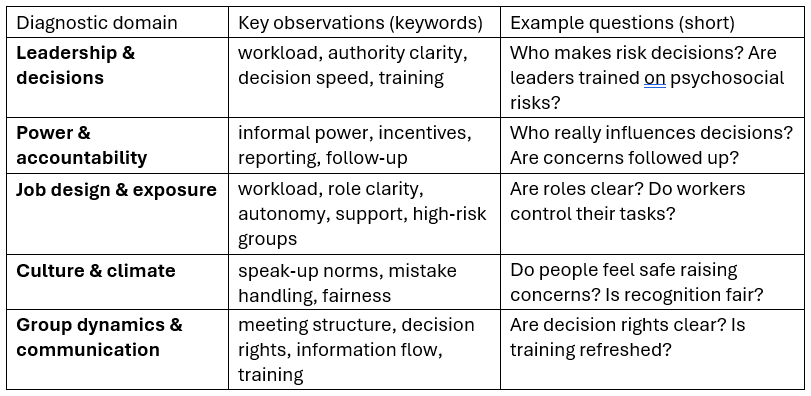
Quick reference table
Notes
· Continuous improvement: Psychosocial risks and controls change over time; the scan should be repeated periodically, and outcomes reviewed[12]. Lessons learned must be captured and systems improved continuously[13].
· Legal context: ISO 45003 is guidance, not law, but regulators expect psychosocial risks to be managed[14]. Integrating psychosocial risk management into WHS due‑diligence helps demonstrate “reasonably practicable” controls and protect leaders from liability.
ISO 45003: Guide and Audit Checklist for Workplace Mental Health
Organizational Behavior, Global Edition – 11 August 2023 by Stephen Robbins (Author), Timothy Judge (Author)