
TeamSTEPPS and WalkRounds
Pre-Event Psychosocial Risk Management Framework 9

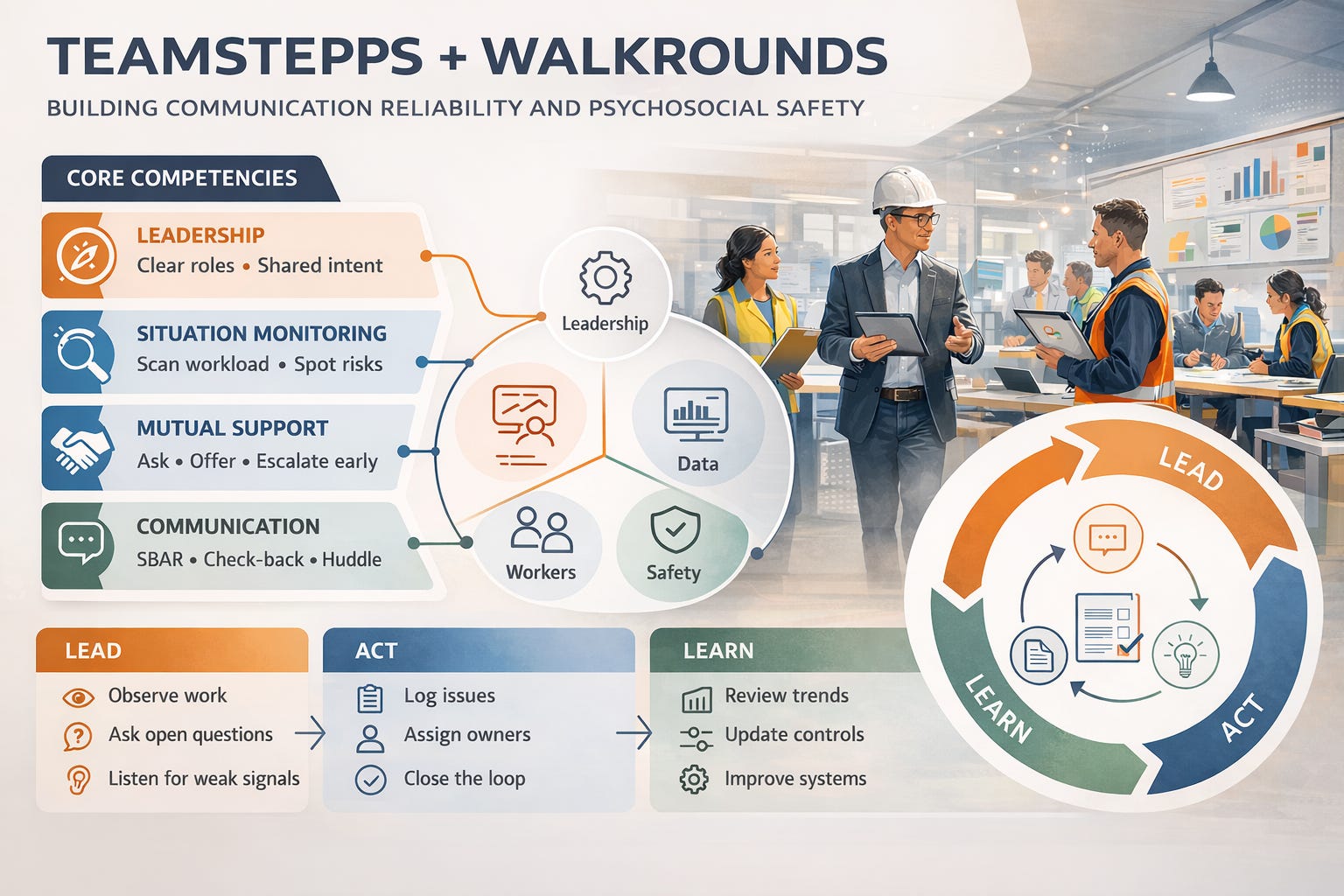
A Systems Approach to Communication Reliability and Psychosocial Safety
Introduction
Communication failure is one of the most persistent and preventable contributors to harm in high-risk work environments. Across healthcare, aviation, defence, and emergency services, incident investigations consistently identify breakdowns in communication, unclear roles, and hierarchical barriers as precursors to both physical and psychological injury.
Under the Work Health and Safety Act 2011 (Qld), these are not soft issues. They are foreseeable psychosocial hazards. Section 19 imposes a primary duty to ensure, so far as is reasonably practicable, the health and safety of workers, including psychological health. Section 27 extends this obligation to officers, requiring due diligence to ensure that appropriate systems are in place and effective.
ISO 45003 reinforces this position. It identifies poor communication, low role clarity, inadequate support, and organisational injustice as core psychosocial hazards that must be actively managed through system-level controls.
TeamSTEPPS and Executive WalkRounds provide one of the most robust and evidence-based responses to these risks.
TeamSTEPPS establishes predictable communication behaviours under pressure. WalkRounds establish leadership visibility, feedback loops, and governance oversight.
Individually, they improve team function. Combined, they form a closed-loop control system that:
· Reduces ambiguity and cognitive overload
· Enables early escalation of risk
· Strengthens psychological safety
· Provides real-time visibility of system failure
This is not cultural aspiration. It is operational control.
The System Problem: Communication as a Psychosocial Hazard
Before examining the frameworks, it is critical to understand the hazard they address.
Psychosocial harm in high-risk environments is rarely caused by isolated events. It emerges from system conditions, including:
· Unclear expectations and role conflict
· Inconsistent or unsafe communication practices
· Hierarchical barriers that suppress speaking up
· Workload imbalance and lack of support
· Fear of blame or reputational consequence
These conditions create chronic strain, decision fatigue, and moral distress.
Research across healthcare and safety-critical industries shows that communication breakdown is a leading contributor to adverse events and near misses (Leonard, Graham, & Bonacum, 2004). These breakdowns are not random. They are predictable outcomes of poorly designed systems.
From a WHS perspective, this places communication squarely within the definition of a controllable hazard.
The question is not whether communication matters.
The question is:
What structured system is in place to make communication reliable under pressure?
What TeamSTEPPS Is
TeamSTEPPS (Team Strategies and Tools to Enhance Performance and Patient Safety) was developed by the United States Department of Defense and the Agency for Healthcare Research and Quality (AHRQ) as a structured framework to improve team performance in high-risk environments.
It is not training alone. It is a behavioural operating system.
The model is built on four interdependent competencies.
1. Leadership
Leadership within TeamSTEPPS is operational, not positional. It is not limited to managers, supervisors, or formal decision-makers. It refers to the behaviours that help a team organise work, maintain clarity, and respond early when risk begins to shift.
In practice, this means leaders create structure before pressure builds. They clarify who is doing what, what risks are expected, what escalation pathway applies, and what support is available if conditions change. This reduces uncertainty, which is one of the most common drivers of psychosocial strain in complex work.
Structured briefings, clear task allocation, shared mental models, and defined escalation pathways all operate as controls. They reduce ambiguity, role conflict, duplication, missed handovers, and hesitation. Under ISO 45003, these are not minor communication issues. They are work design and social factors that influence psychological health and safety.
Where leadership is weak, workers are left to interpret priorities on their own. They may be unsure whether to escalate, interrupt, challenge, pause work, or absorb extra load. That increases cognitive load and decision fatigue. It also creates fertile ground for blame when things go wrong.
TeamSTEPPS makes leadership visible through routine behaviours. Briefings set direction. Huddles adjust the plan. Debriefs capture learning. Escalation tools give people permission to speak before harm occurs. This turns leadership from a personality trait into a repeatable safety practice.
The key point is simple. Role clarity is not just a productivity issue. It is a psychosocial risk control.
2. Situation Monitoring
Situation monitoring is the disciplined practice of noticing what is changing before failure becomes obvious. It requires teams to maintain awareness of workload, environmental conditions, staffing levels, fatigue, emotional load, competing priorities, and emerging hazards.
In many organisations, psychosocial risk is only recognised after visible breakdown. Someone burns out. Conflict escalates. A complaint is lodged. A near miss occurs. Situation monitoring pushes the organisation upstream by asking: what weak signals are already present?
This includes signs such as repeated interruptions, rushed decisions, missed breaks, unresolved conflict, poor handovers, increased errors, withdrawal, frustration, or workers quietly absorbing unsafe workloads. These signals often appear well before formal reporting systems capture them.
From a WHS perspective, situation monitoring supports early hazard identification. It aligns with due diligence because officers and leaders cannot verify risk control effectiveness if the organisation has no reliable way to detect deterioration.
In TeamSTEPPS, situation monitoring is not passive observation. It is active checking. Teams look at the task, the environment, the people, and the progress of work. They ask whether workload is fairly distributed, whether support is needed, and whether the current plan still fits the conditions.
This matters for psychosocial safety because pressure rarely arrives neatly labelled. It shows up as confusion, short tempers, silence, rework, and avoidable friction. Without structured monitoring, those signals are dismissed as personality issues.
Done well, situation monitoring gives teams permission to intervene early. It helps prevent overload, fatigue, interpersonal conflict, and avoidable distress from becoming normalised.
3. Mutual Support
Mutual support is the TeamSTEPPS competency that turns teamwork into a protective control. It formalises the behaviours that allow workers to ask for help, offer help, redistribute workload, and intervene when someone is struggling or when risk is increasing.
This is important because many psychosocial hazards worsen when workers feel they must cope alone. High workload, emotional demands, conflict, customer aggression, time pressure, and unclear expectations become more harmful when support is inconsistent or unsafe to request.
Mutual support reduces the burden on the individual by making support a team responsibility. It shifts the message from “you should be more resilient” to “we design the work so people are not left carrying unmanaged risk alone.” That is a stronger WHS position and a more defensible governance position.
In practice, mutual support includes checking capacity, backing up colleagues, stepping in when someone is overloaded, using graded assertiveness, and making help-seeking normal. It also includes respectfully challenging unsafe decisions or behaviours before they escalate.
This is where psychological safety becomes practical. It is not a slogan about being nice. It is the ability to raise concerns, ask for assistance, admit uncertainty, and challenge risk without fear of humiliation or punishment.
Where mutual support is absent, workers often delay escalation. They may fear looking incompetent, being judged, or being seen as difficult. Over time, that silence becomes a system hazard.
TeamSTEPPS gives teams a shared language for support. This reduces awkwardness, improves trust, and makes intervention more acceptable. It also helps leaders distinguish between individual performance issues and system conditions that are placing people under unreasonable strain.
4. Communication
Communication is the most visible part of TeamSTEPPS, but it is often misunderstood. It is not about telling people to “communicate better.” That kind of advice is too vague to control anything.
TeamSTEPPS treats communication as a system process. It introduces structured tools that reduce variation, assumptions, hierarchy barriers, and information loss. These tools include SBAR, check-back, call-outs, huddles, CUS, and debriefs.
Each tool serves a different control function. SBAR creates a clear format for escalation. Check-back confirms that information has been received and understood. Call-outs make critical information visible to the whole team. Huddles help teams adjust quickly when conditions change. CUS gives workers a graded way to raise concern. Debriefs support learning after events.
From a psychosocial risk perspective, these tools reduce uncertainty and interpersonal risk. They make it easier for workers to speak up, clarify instructions, challenge unsafe conditions, and process difficult events. This is particularly important in workplaces where hierarchy, time pressure, customer aggression, or professional status can suppress communication.
Poor communication increases cognitive load. Workers have to guess, interpret, chase missing information, or carry unclear expectations. Over time, this creates frustration, stress, conflict, and avoidable error.
Structured communication reduces that load. It gives people a script when pressure is high. That matters because people rarely communicate at their best when they are tired, rushed, intimidated, or under scrutiny.
In WHS terms, these tools operate as administrative and behavioural controls. They do not remove the hazard on their own, but they make interaction more reliable and escalation more predictable.
The blunt test is this: if your organisation depends on confidence, personality, or goodwill for critical communication, the control is weak. TeamSTEPPS strengthens that control by making communication repeatable.
Evidence for TeamSTEPPS
The research record on TeamSTEPPS is unusually robust. Meta‑analyses and longitudinal studies show that training teams in structured communication and mutual support leads to fewer adverse events, better handover quality and higher rates of speaking up. Importantly, these gains are not just nice‑to‑have; they directly address psychological hazards such as ambiguity, isolation and role conflict. Reduced errors mean fewer unexpected traumatic events and less moral injury. Weaver et al. (2010) showed that TeamSTEPPS implementations improved teamwork perceptions and safety culture. Other studies report reductions in burnout when the tools are embedded in daily practice.
However, the evidence also shows that training alone does not create lasting change. Without reinforcement through leadership behaviours, governance processes and accountability, the benefits decay. This is where due diligence comes in: officers cannot simply send staff to a workshop and tick a box. Under Australian WHS law and ISO 45003, they must ensure training is integrated into systems, monitored, and reviewed for effectiveness. Anything less is lip service. A complacent board should be told bluntly that failure to invest in systems and reinforcement will waste their training budget and expose them to foreseeable psychosocial hazards.
What Executive WalkRounds Are (and Are Not)
Too many organisations confuse WalkRounds with audits or “management by walking around.” WalkRounds are not compliance inspections; they are leadership interventions designed to uncover system risks and build trust. Executives and directors walk the floor, ask open questions, listen without defensiveness and close the loop on issues raised. They surface latent hazards, not just obvious ones. Frankel et al. showed that when leaders act on feedback from WalkRounds, safety concerns increase in reporting and climate improves. Done properly, WalkRounds are governance in action: leaders verify whether psychosocial controls are working, demonstrating their personal due diligence.
From a psychosocial perspective, WalkRounds reduce the perception that management is indifferent, lessen fear of escalation and bridge the gap between boardroom narratives and frontline reality. Workers see that speaking up is expected and safe, which counteracts hazards like low job control and isolation. A poorly executed WalkRound, however—where leaders wander around, fail to listen or never follow up—creates secondary risk. It teaches workers that raising concerns is pointless, eroding trust and breeding cynicism. In Australia, that is a failure of consultation duties and a breach of ISO 45003’s requirement for meaningful worker participation.
TeamSTEPPS Tools as Psychosocial Controls
SBAR (Situation, Background, Assessment, Recommendation) – This structured format ensures that escalation is concise and complete. It reduces fear of speaking up and cognitive overload because workers no longer have to improvise under pressure. For junior staff, SBAR provides a legitimate script for addressing senior clinicians or managers. In psychosocial terms, it mitigates hazards like role ambiguity and hierarchical intimidation. Boards should require SBAR‑style escalation for all high‑risk communications and audit its use. Not using it is a foreseeable risk.
Check‑Back – This simple “I give information, you repeat it back, I confirm” loop ensures information is understood. It combats miscommunication, which is a major source of errors and interpersonal conflict. In high‑pressure environments, assumptions are common; Check‑Back forces explicit confirmation. For psychosocial risk management, it reduces role confusion and the stress of uncertainty. Leaders should model and expect check‑backs; failure to do so invites blame and cognitive strain.
Huddles – Brief, structured team check‑ins redistribute workload, identify early risks and align the team. They function as micro‑interventions that prevent overload, fatigue and interpersonal tension. Regular huddles demonstrate that adjusting plans based on worker input is normal, satisfying ISO 45003’s requirement for participatory risk management. A team that never huddles leaves psychosocial signals undetected until they become crises.
CUS (I’m Concerned, I’m Uncomfortable, this is a Safety issue) – This graded assertiveness tool gives workers a sanctioned language to challenge unsafe conditions. It lowers power‑distance barriers and ensures escalation happens before harm. Without a tool like CUS, workers may remain silent, fearing reprisal or ridicule. Boards should ask: do our staff have a simple, accepted way to raise psychosocial hazards? If not, expect to read about those hazards in the coroner’s report.
Debriefs – Structured reflection after events supports learning, emotional processing and system improvement. Debriefs buffer against cumulative stress and moral injury by giving staff space to process what happened and to influence system changes. They should be confidential, non‑punitive and integrated into the risk register. In Australia, neglecting to debrief after traumatic or near‑miss incidents may breach the duty to provide psychological safety.
Collectively, these tools transform vague expectations to “communicate” into repeatable psychosocial controls. Boards should measure their adoption, not just provide laminated cards.
WalkRounds as Psychosocial Risk Detection
Effective WalkRounds are not casual chats; they involve open‑ended questioning, active listening, equal participation, documented follow‑up and integration into risk systems. The most critical element is closing the feedback loop—responding visibly to concerns raised. If workers raise issues and no action is seen, trust is eroded and secondary psychosocial risk is created. Leaders must therefore commit to follow‑up timelines and communicate outcomes.
From a governance perspective, WalkRounds should feed directly into risk registers and due‑diligence reports. Issues raised should be tracked through to resolution, with accountability assigned. This satisfies ISO 45001’s requirement for participation and consultation and demonstrates to regulators that the PCBU takes psychosocial hazards seriously. Executives who simply “walk around” without this rigour are wasting time and exposing their organisation to reputational and legal risk.
In summary, the remaining sections of your document highlight the importance of evidence, leadership engagement, tool integration and feedback loops in psychosocial risk management. Expand them into robust arguments: training must be reinforced, WalkRounds must be purposeful, tools must be embedded, and leaders must be accountable. Anything less is theatre.
Case Studies
US Veterans Health Administration
The United States Veterans Health Administration represents one of the largest system-wide implementations of TeamSTEPPS, supported by leadership WalkRounds as a reinforcement mechanism.
The intervention was not limited to training. It involved:
• Standardised communication protocols across multidisciplinary teams
• Structured briefings and debriefings embedded into daily work
• Executive WalkRounds to surface frontline concerns and reinforce behaviours
• Ongoing measurement of safety culture and communication reliability
Following implementation, multiple facilities reported:
• Improved TeamSTEPPS Teamwork Perceptions Questionnaire scores
• Increased frequency of speaking-up behaviours, particularly among junior nurses
• Reduction in medication errors linked to communication breakdown
The critical shift was behavioural standardisation.
Prior to implementation, communication was variable and dependent on hierarchy. Junior staff often hesitated to escalate concerns due to uncertainty or fear of reprisal. After implementation, tools such as SBAR and CUS provided a shared escalation language, reducing interpersonal risk.
WalkRounds reinforced this by making escalation visible and legitimate. Leaders actively sought input and demonstrated follow-through, which strengthened trust.
From a WHS perspective, this case demonstrates a direct control pathway:
Unstructured communication → ambiguity and hesitation → error risk
Structured communication + leadership reinforcement → clarity and early escalation → risk reduction
This is a clear example of a psychosocial hazard being controlled through system design rather than individual resilience.
Available at: https://www.ahrq.gov/teamstepps/evaluation/index.html
Australian Hospital Network
In an Australian tertiary hospital network, Executive WalkRounds were introduced with a structured feedback and accountability model.
Unlike traditional leadership walk-throughs, these WalkRounds included:
• Pre-defined open-ended questions focused on system risk
• Documentation of issues raised during each round
• Formal allocation of responsibility for follow-up actions
• Feedback loops visible to staff within defined timeframes
The results included:
• Reduction in burnout scores measured using the Maslach Burnout Inventory
• Increased psychological safety scores across clinical teams
• Higher engagement in safety reporting and discussion
The mechanism behind these outcomes is critical.
Burnout in healthcare is strongly linked to perceived lack of control, poor support, and organisational injustice. WalkRounds addressed these factors by:
• Making leadership accessible
• Demonstrating that concerns lead to action
• Reducing the gap between frontline experience and executive awareness
Psychological safety increased not because staff were encouraged to speak, but because they saw that speaking led to change.
This aligns directly with ISO 45003, which identifies organisational support, fairness, and leadership behaviour as key determinants of psychosocial risk.
From a due diligence perspective, WalkRounds created a visible governance loop:
Hazard identification → leadership awareness → action → feedback → trust
Without the feedback loop, WalkRounds become symbolic. With it, they become a control.
Available at: https://bmjqual-safety.bmj.com/content/23/12/973
Emergency Services Agency (United States)
Emergency services operate in environments characterised by acute stress, time pressure, and high consequence decision-making. These conditions create elevated risk of interpersonal conflict, cognitive overload, and psychological strain.
In this context, TeamSTEPPS was introduced as a structured communication and teamwork framework, supported by regular debriefs and leadership engagement.
Key elements of implementation included:
• Scenario-based communication training under simulated pressure
• Use of structured tools such as SBAR, check-backs, and huddles
• Routine post-incident debriefs focusing on both operational and relational factors
• Reinforcement of mutual support behaviours across teams
Outcomes reported included:
• Reduction in interpersonal conflict during operations
• Improved trust between team members and across ranks
• Lower turnover rates, particularly in high-demand units
The underlying mechanism was the reduction of uncertainty and interpersonal friction.
In high-pressure environments, conflict often arises not from personality differences, but from:
• Miscommunication
• Unclear expectations
• Perceived lack of support
By standardising communication and normalising mutual support, TeamSTEPPS reduced these friction points.
Debriefs played a dual role:
• Supporting learning and performance improvement
• Providing psychological decompression after high-stress events
This is particularly relevant to psychosocial risk management. Exposure to repeated high-stress incidents without structured processing increases the risk of cumulative psychological harm.
From a WHS perspective, this case highlights that:
Psychosocial risk is not limited to healthcare
It is inherent in any environment where pressure, uncertainty, and consequence intersect
TeamSTEPPS provides a transferable control model across these contexts.
Available at: https://www.ahrq.gov/teamstepps/long-term-care/index.html
What These Case Studies Actually Prove
Across all three cases, the pattern is consistent:
• Communication became structured and predictable
• Hierarchy barriers were reduced
• Leadership became visible and responsive
• Workers experienced increased support and clarity
The outcomes were not driven by awareness or training alone.
They were driven by system-level changes to how people interact under pressure.
From a WHS and ISO 45003 perspective, this is the key point:
These interventions convert communication from an informal behaviour into a controlled system process.
That is the shift most organisations have not yet made.
And that is where the real risk still sits.
Integration into WHS and ISO 45003 Frameworks
These interventions align directly with psychosocial risk categories.
Work organisation
Clear roles and structured workflows reduce ambiguity.
Social factors
Improved communication reduces conflict and increases trust.
Leadership
Visible engagement strengthens psychological safety.
Work environment
Early detection of system strain enables intervention before harm occurs.
Implementation Framework
Implementation of TeamSTEPPS and WalkRounds must follow a staged approach. Organisations that skip stages or treat this as a training rollout typically see short-term uptake followed by behavioural decay.
Stage 1: Establish core behaviours
The first stage focuses on introducing foundational communication tools such as SBAR, huddles, and CUS. The objective is not awareness but behaviour adoption under real work conditions. Teams must practice structured communication in daily tasks, not simulated environments alone. Leaders should reinforce usage in routine interactions to normalise these behaviours. At this stage, variability is expected, but consistency must be actively driven.
Stage 2: Introduce WalkRounds as a reinforcement mechanism
Once basic behaviours are visible, WalkRounds are introduced to create leadership visibility and feedback loops. This involves structured, open-ended questioning focused on system risks rather than compliance. Issues raised must be documented and categorised, with early feedback provided to teams. The purpose here is to signal that communication is not only expected, but acted upon.
Stage 3: Integrate into governance systems
At this point, insights from TeamSTEPPS behaviours and WalkRounds must be embedded into formal WHS processes. Recurring issues should be mapped to psychosocial hazards and entered into risk registers. Trend analysis should inform leadership reporting and decision-making. This is where the intervention shifts from cultural initiative to governance control, aligning with ISO 45003 requirements for systematic risk management.
Stage 4: Embed and sustain
Sustainability depends on routine. This includes ongoing TeamSTEPPS refresher training, scheduled WalkRounds across all operational areas, and normalised use of debriefs following significant tasks or events. These practices must become part of “how work is done,” not additional activities.
Limitations
TeamSTEPPS and WalkRounds are not standalone solutions.
They do not redesign work, reduce workload, or remove systemic pressures. They also do not replace formal risk assessments or organisational controls. Their function is to stabilise communication and surface risk earlier, not eliminate it.
Effectiveness depends on:
• Skilled facilitation to maintain psychological safety
• Consistent leadership behaviour and follow-through
• Integration into existing WHS and governance systems
Without these elements, organisations may see initial engagement but limited long-term impact.
Conclusion
TeamSTEPPS and WalkRounds provide a structured, evidence-based method for improving communication reliability and reducing psychosocial risk.
They move organisations from:
Reactive response
to
Proactive detection and control
From a due diligence perspective, they answer a critical question:
How does the organisation ensure that risks are identified early, communicated clearly, and acted on consistently?
If no structured system exists, the risk is not being managed.
Reference
Agency for Healthcare Research and Quality. TeamSTEPPS Program. Available at: https://www.ahrq.gov/teamstepps/index.html
Weaver, S. J., et al. (2010). Does teamwork improve performance in healthcare? Available at: https://pubmed.ncbi.nlm.nih.gov/20693221/
Frankel, A., et al. (2003). Patient safety leadership WalkRounds. Available at: https://pubmed.ncbi.nlm.nih.gov/14645891/
Leonard, M., Graham, S., & Bonacum, D. (2004). The human factor in healthcare. Available at: https://pubmed.ncbi.nlm.nih.gov/15576692/
ISO 45003. Psychological health and safety at work. Available at: https://www.iso.org/standard/64283.html