
SHIELD Framework
Pre-Event Psychosocial Risk Management Framework 18

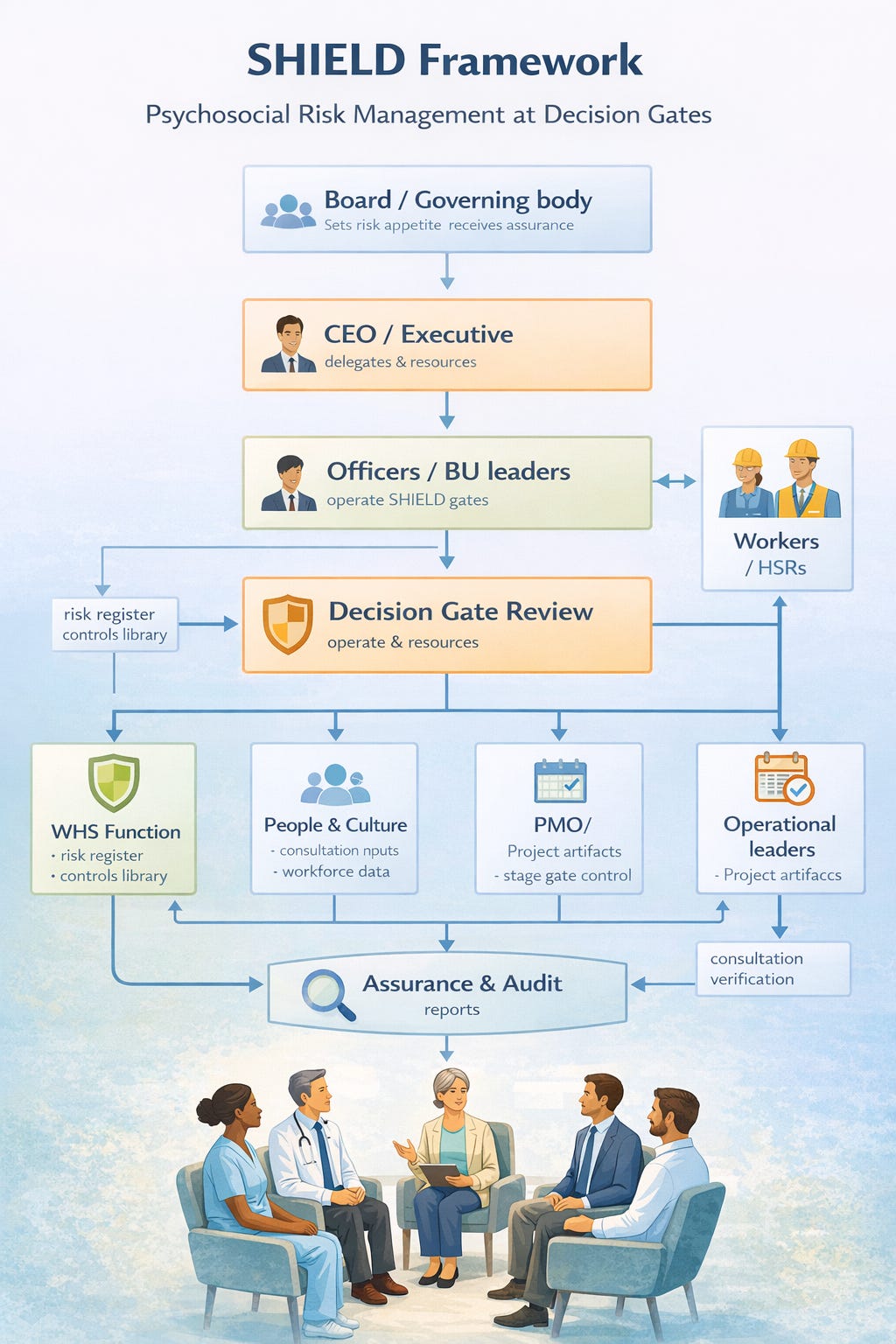
The Shield Framework is a governance-grade, pre-event psychosocial risk management method designed to prevent harm before decisions become downstream psychosocial exposures. It does this by embedding a structured psychosocial hazard identification and control selection process at decision gates (for example: restructures, roster redesign, workload uplift, technology rollouts, policy changes, procurement/vendor changes, budget cuts, operating model changes). This is not a “wellbeing program.” It is a risk control and assurance mechanism that strengthens officer due diligence, improves traceability, and supports defensible “reasonably practicable” decision-making under Australian WHS regimes and guidance aligned to ISO 45003 principles. 1
In the Australian context, the strategic case for Shield is that psychosocial hazards are explicitly understood as arising from the design or management of work, the work environment, plant, and workplace interactions and behaviours.2 If decisions change any of those inputs, then—governance logic follows—those decisions must be treated as potentially introducing (or increasing) psychosocial risk and therefore should be managed through a documented risk management process with consultation and review.3
A key governance advantage of Shield is that it operationalizes what the evidence on psychosocial risk repeatedly shows: management systems and leadership-driven climates shape job demands and other psychosocial risk factors, so the “control point” that matters most is often upstream (work design, resources, priorities, sequencing, role clarity, change management), not downstream “resilience” training.4
This report provides: a defensible framework definition; ISO 45003 and Australian WHS alignment; mermaid diagrams for flow and governance relationships; implementation steps; a practical checklist; a governance (RACI-style) matrix; comparison tables against RADAR/BRIDGE/CREW and external frameworks; and Substack-ready citation guidance using APA 7 plus numbered superscript endnote links.5
Regulatory and standards context
Australian WHS practice (including regulator guidance) frames psychosocial hazards as WHS hazards requiring the same discipline applied to physical hazards: identify hazards, assess risks, implement controls using a hierarchy, and review effectiveness—supported by worker consultation.3 Under Safe Work Australia’s model guidance, PCBUs must eliminate or minimize psychosocial risks so far as is reasonably practicable, and codes of practice provide practical guidance but require jurisdictional approval to have legal effect.1
A practical compliance nuance for executives: codes of practice are not “optional reading.” Even where not adopted verbatim, they are commonly admissible as evidence of known control expectations and good practice; departures need to meet an equivalent or higher standard.1
Some jurisdictions have moved beyond guidance into explicit psychosocial risk regulation. For example, reforms commencing 1 April 2023 in Queensland inserted a dedicated psychosocial risks division defining psychosocial hazards and psychosocial risks and requiring psychosocial risks to be managed under general risk management duties, including considering relevant matters when determining controls.6 The Commonwealth WHS Regulations compilation also contains a psychosocial risks division (regs 55A–55D).7
Officer governance obligations matter because psychosocial risk management is increasingly examined through a due diligence lens: officers are expected to ensure appropriate systems are in place and operating to manage WHS obligations. This is where Shield provides a distinctive governance value: it makes “we considered psychosocial risk” auditable at the same decision points where financial, operational, privacy, security, and clinical risks are routinely documented.
ISO 45003 (and its Australian/New Zealand adoption via AS/NZS ISO 45003) contributes the management-system discipline: psychosocial risks are managed within an OH&S management system aligned to ISO 45001, with guidance applicable across sectors and organization sizes.5 In other words, Shield can be positioned as a practical mechanism to evidence ISO-aligned practices: leadership commitment, worker participation, hazard identification, risk assessment, operational control selection, and continual improvement.5
Finally, the “tools landscape” is changing. People at Work, long positioned by multiple Australian regulators as an evidence-based psychosocial risk assessment survey tool, has announced decommissioning in 2026, with key dates beginning 1 June 2026 (final date for new accounts), 1 July 2026 (final date for new surveys), and 2 October 2026 (final platform access).9 This is not an argument against surveys; it is a governance reminder that Shield should not rely on any single tool as the “proof of psychosocial compliance.” Shield is tool-agnostic: it governs decisions and controls, regardless of the measurement instrument.
The Shield Framework
a. Definition and intent
Shield is defined as Structured Hazard Identification at Decision Gates: a repeatable, documented method applied at critical organizational decision points to ensure psychosocial hazards are anticipated, evaluated, controlled, and tracked before implementation.
Its intent is to prevent the “governance slip” where decisions create predictable psychosocial strain (for example, unresourced workload increases, role ambiguity, poor change sequencing, higher exposure to aggression, inequitable rostering, degraded supervision ratios) because psychosocial impacts were not assessed when approval was granted. Safe Work Australia’s list of common psychosocial hazards directly includes workload/job demands, low control, poor support, lack of role clarity, poor organizational change management, violence and aggression, bullying/harassment, and conflict/poor workplace relationships—each of which can be created or amplified by upstream decisions.10
Conceptually, Shield is consistent with the direction of leading evidence and guidance: prioritize organizational and work-design interventions over downstream individual coping approaches, and treat prevention as the core strategy. 11
b. The SHIELD sequence
Shield is executed through six components, used as a structured gate review:
S — Signal detection
Detect triggers that a decision may introduce or change psychosocial exposure (e.g., “this decision affects workload, autonomy, supervision, change load, customer aggression exposure, staffing, performance expectations, or team stability”). This reflects the regulator framing that psychosocial hazards arise from work design/management, environment, plant, and interactions.2
H — Hazard identification
Use a structured checklist aligned to recognized psychosocial hazard categories (job demands, low control, poor support, role clarity, change management, organizational justice, traumatic exposure, remote/isolated work, physical environment, violence/aggression, bullying/harassment, conflict).10
I — Impact anticipation
Assess how the decision might influence wellbeing, team dynamics, psychological safety, work patterns, emotional load, and cumulative burden. This is consistent with management-system thinking in ISO 45003 (risk within an OH&S management system) and with the evidence that management climates influence demands and strain.5
E — Evaluation
Evaluate likely severity, likelihood, cumulative exposure, and affected populations; document the basis for “reasonably practicable” control selection (particularly for high-risk worker groups or high-change environments). The WHS risk management approach and hierarchy of controls logic apply equally here. 12
L — Leadership controls
Select and resource controls that target root causes (work redesign, staffing, sequencing, supervision models, role clarity, workload governance, change communication and participation), with administrative controls and individual supports used as secondary layers. This ordering aligns to hierarchy-of-control principles and Total Worker Health guidance emphasizing upstream controls.13
D — Documentation and decision
Record hazards, controls, owners, timelines, consultation outcomes, residual risk acceptance, and post-implementation review triggers. This supports officer due diligence by creating traceable records of the decision basis and control rationale.8
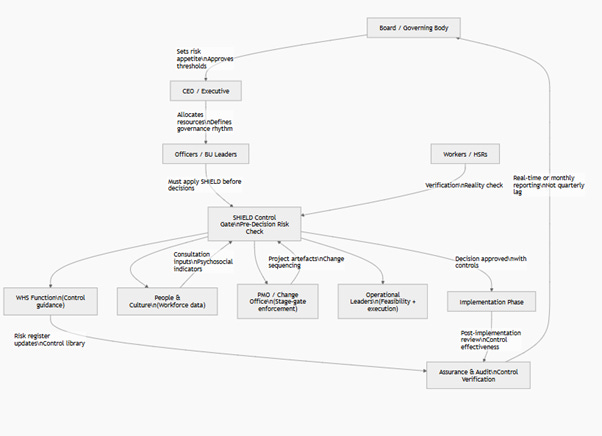
Framework flow diagram
Governance and assurance design
Why Shield is a governance control, not a “program”
From a governance perspective, psychosocial hazards are not limited to interpersonal misconduct. Regulators explicitly treat hazards like workload, low control, poor support, unclear roles, and poor change management as psychosocial hazards.10 These hazards are frequently introduced by executive decisions—often rational decisions—when risk controls are not explicitly designed alongside the change.
Shield therefore functions as a primary preventive control for decision-driven psychosocial risk. It is comparable in governance intent to structured clinical governance, privacy impact assessments, or safety-in-design reviews: it ensures “risk thinking” occurs before commitment.
This positioning is supported by evidence that management-driven psychosocial climates (for psychological health and safety) influence work conditions and mental health outcomes.4 It is also consistent with systematic review findings that organizational-level interventions can produce mental health benefits when they increase worker control, improve demands, or improve support—while some participatory interventions during redundancies can worsen health outcomes if poorly executed. 14
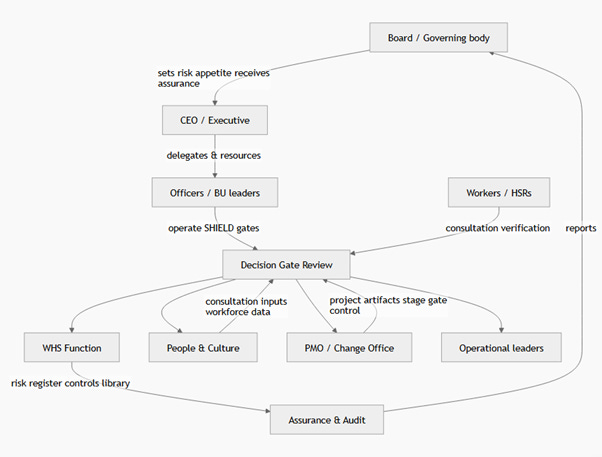
Governance relationships diagram
Shield decision gates
Shield should be triggered by decision categories that are known to alter psychosocial exposure pathways. A practical set of triggers aligned to regulator hazard lists include:10
Workforce change: restructures, role redesign, position removals, contractor/vendor substitution, centralization, supervision ratio changes
Operational change: new KPIs/targets, workload uplift, new rosters, shift pattern changes, overtime reliance, reduced staffing, new triage models
Customer/community risk: new frontline exposure patterns, security changes, changes in service access, complaint/escalation pathways (violence/aggression risk)
Digital/technology change: automation, monitoring tooling, scheduling systems, EMR rollout, call routing, algorithmic performance management
Policy/process change: performance management, flexible work rules, leave rules, disciplinary processes, reporting/complaints changes
Physical environment/plant changes that affect psychosocial risk: layout, noise, thermal comfort, remote work tooling (where these contribute to stress or fatigue pathways)12
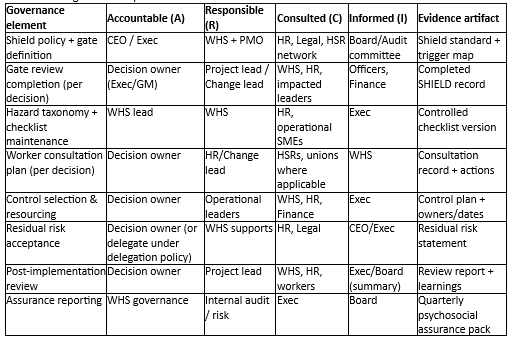
Governance matrix
A defensible governance matrix clarifies accountability for the SHIELD artifact, risk acceptance, and monitoring. This example is deliberately “board-ready,” aligned to officer due diligence expectations and risk management discipline.
Implementation playbook
1. Implementation approach
Implementation should be treated as a management system change, not a standalone initiative. ISO 45003 explicitly frames psychosocial risk management within an OH&S management system based on ISO 45001, implying governance integration, documented processes, and continual improvement rather than campaign-based activity.5
A defensible sequencing (designed for mixed executive + practitioner audiences):
Design (weeks 1–4)
Define Shield scope, decision triggers, risk appetite, and minimum evidence requirements per gate (e.g., “no restructure approval without Shield”). Ensure the artifact integrates with your existing risk management processes (risk register, change stage gates, procurement governance). This aligns with the general WHS risk management code approach and psychosocial code guidance.15
Build (weeks 4–8)
Create the Shield pack: 1-page signal screen, hazard checklist, impact assessment sheet, control library, consultation guide, and a standard sign-off page. Align hazard categories to Safe Work Australia guidance for psychosocial hazards and your jurisdiction’s definitions.10
Pilot (weeks 8–16)
Pilot Shield in three decision types: one operational change (rostering/workload), one project-based change (technology/process rollout), one people change (role redesign). Capture cycle time, friction points, and control effectiveness early.
Scale (quarter 2 onward)
Make Shield mandatory through governance. Add assurance reporting and sampling-based quality review (e.g., internal audit checks: “were hazards identified, were controls resourced, was consultation meaningful, was review completed?”). This supports officer due diligence evidence.8
2. Practical Shield checklist
This checklist is structured to be used at a decision gate meeting. It is intentionally brief but defensible.
Trigger confirmation
Does this decision change workload, staffing, autonomy, supervision, role clarity, change load, customer aggression exposure, performance expectations, or team structures?10
If yes: Shield required at this gate.
Minimum hazard scan (H)
Which Safe Work Australia psychosocial hazard categories are plausibly affected (select all that apply and state mechanism)? 10
Is there foreseeable interaction between hazards (e.g., high demands + low control + poor support)? (Document interaction and cumulative burden.)
Populations & equity (I)
Which worker groups are most impacted (frontline, remote, new workers, night shift, supervisors, client-facing, culturally diverse teams)?
Are there foreseeable inequities (e.g., rostering fairness, access to training/support, exposure to aggression, remote isolation)? 10
Risk evaluation (E)
Severity and likelihood (with rationale)
Exposure duration (temporary change vs permanent operating model)
Existing controls and their limits (what fails under stress?)15
Controls (L)
Work design controls first: remove/avoid hazard where practicable (sequencing, resourcing, remove unnecessary work, clarify roles, redesign targets). 13
Administrative controls: policies, supervision models, training, escalation pathways
Individual supports: EAP, peer support, wellbeing tools (not the primary control)16
Consultation
What consultation occurred (who, when, what changed as a result)? Regulator guidance emphasizes consultation through each step of psychosocial risk management.3
Documentation (D)
Owners, dates, review checkpoints
Residual risk statement and approval authority
Post-implementation verification plan (what will you check; what data will you use)
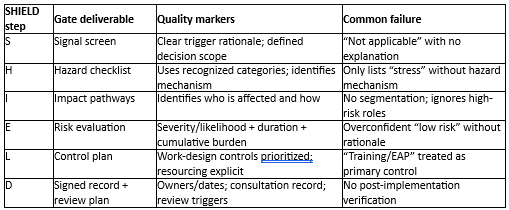
3. Decision gate artifact table
This table shows what “good” looks like for evidence artifacts expected at each step.
Measurement, metrics, and evaluation
Measurement principles
Measurement needs to be multi-layered: process metrics (did we execute Shield), leading indicators (is risk rising), and lagging outcomes (harm indicators). This reflects the four-step WHS risk management cycle and the management-system orientation of ISO 45003/45001 toward continual improvement (Plan-Do-Check-Act).3
An evidence-based caution: psychosocial interventions and workplace reorganization effects vary and study designs are often imperfect; executives should treat single indicators (EAP utilization, single survey scores) as insufficient assurance. Systematic reviews of organizational interventions show mixed strength of evidence, but do support the logic that improving control/demands/support can yield mental health benefits, and that poorly executed change alongside redundancies can worsen outcomes.14
Core Shield KPIs
Process and governance
% of qualifying decisions that completed Shield before approval
Median time to complete Shield gate review (cycle time)
% of Shield actions closed on time
% of decisions with documented worker consultation and resulting design changes3
Risk quality
Hazard distribution by category (workload, role clarity, change mgmt, aggression, etc.) aligned to regulator categories10
% of controls that are “work design/system” vs “individual support” (a proxy for control quality), aligned to hierarchy-of-controls logic13
Leading indicators (examples; tailor to sector)
Overtime hours, shift swaps, vacancy rates, supervisor span-of-control, backlog/queue measures (workload pressure)
Change load index (number of concurrent changes affecting same teams)
High-risk incident precursors: aggression reports, complaint escalations, near-miss psychosocial incidents, turnover hotspots10
Lagging outcomes
Psychological injury claims trends (with caution on underreporting and claims lag)
Absenteeism and turnover (triangulated with workload/change data)
Incident notifications and serious events (note: model law updates have moved toward expanded notification categories including violent incidents and work-related suicide/attempted suicide, emphasizing governance attention to these harms).5
Evaluation approach
A defensible evaluation model uses triangulation:
Quantitative trend review (pre/post change, compared across similar units where available)
Qualitative verification (worker consultation feedback, supervisor debriefs, learning reviews)
Assurance sampling (audit a subset of decisions for completeness and adequacy)
This proposal is consistent with the “step-by-step risk assessment approach” emphasized by the UK HSE Management Standards for work-related stress (while recognizing UK guidance is not Australian law, it is a respected risk assessment model). It also aligns to WHO guidance prioritizing evidence-based organizational interventions for workplace mental health and the broader prevention framing. 11
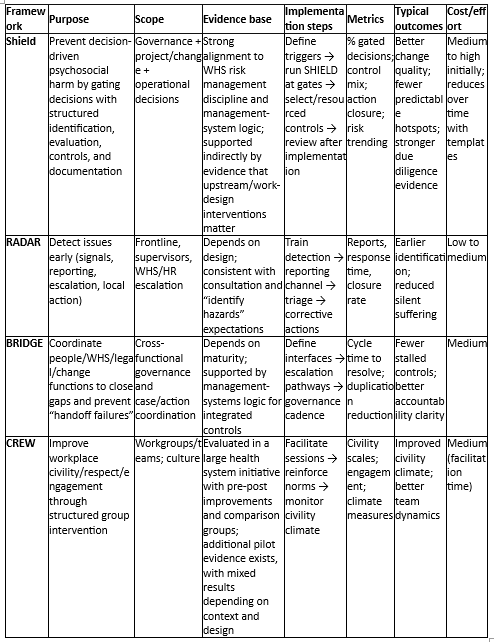
Comparison to RADAR, BRIDGE, and CREW
Because RADAR and BRIDGE are series frameworks (often organization-specific), this comparison treats them as typical functions implied by their names in psychosocial governance programs: RADAR (frontline detection/escalation), BRIDGE (connection/coordination across functions and levels), CREW (culture/civility intervention). Replace the “implementation steps” lines below with your internal definitions if they differ.
References
1. Safe Work Australia. (2022). Model Code of Practice: Managing psychosocial hazards at work. https://www.safeworkaustralia.gov.au/doc/model-code-practice-managing-psychosocial-hazards-work
2. International Organization for Standardization. (2021). ISO 45003:2021 Occupational health and safety management — Psychological health and safety at work — Guidelines for managing psychosocial risks. https://www.iso.org/standard/64283.html
3. ISO. (2018, reviewed 2024). ISO 45001:2018 Occupational health and safety management systems — Requirements with guidance for use. https://www.iso.org/standard/63787.html
4. Standards Australia. (2023). AS/NZS ISO 45003:2021 Occupational health and safety management – Psychological health and safety at work – Guidelines for managing psychosocial risks. https://store.standards.org.au/product/as-nzs-iso-45003-2021
5. Safe Work Australia. (Updated 5 Dec 2025). Model Work Health and Safety Act (current version and amendment notes). https://www.safeworkaustralia.gov.au/doc/model-work-health-and-safety-act
6. Comcare. (Regulatory guide; accessed 2026). Managing psychosocial hazards (WHS Regulations 55A–55D guidance). https://www.comcare.gov.au/scheme-legislation/whs-act/regulatory-guides/managing-psychosocial-hazards
7. World Health Organization. (2022). Guidelines on mental health at work. https://www.who.int/publications/i/item/9789240053052
8. World Health Organization & International Labour Organization. (2022). Mental health at work: policy brief. https://iris.who.int/items/f4f4bf1b-4745-4ca9-997c-f5e912ed7cc9
9. Centers for Disease Control and Prevention / NIOSH. (2024). Hierarchy of Controls Applied to NIOSH Total Worker Health. https://www.cdc.gov/niosh/twh/php/hierarchy/index.html
10. Health and Safety Executive. (UK). (n.d.). What are the Management Standards? https://www.hse.gov.uk/stress/standards/overview.htm
11. Safe Work Australia. (n.d.). Identifying, assessing, controlling and reviewing psychosocial hazards. https://www.safeworkaustralia.gov.au/safety-topic/managing-health-and-safety/mental-health/managing-risks/identifying-assessing-controlling-and-reviewing
12. Egan, M., Bambra, C., Thomas, S., Petticrew, M., Thomson, H., & Whitehead, M. (2007). The psychosocial and health effects of workplace reorganisation: Systematic review of organisational-level interventions to increase employee control. Journal of Epidemiology & Community Health, 61(11), 945–954. https://pmc.ncbi.nlm.nih.gov/articles/PMC2465601/
13. LaMontagne, A. D., Keegel, T., Louie, A. M., Ostry, A., & Landsbergis, P. A. (2007). A systematic review of the job-stress intervention evaluation literature, 1990–2005. International Journal of Occupational and Environmental Health, 13(3), 268–280. https://pubmed.ncbi.nlm.nih.gov/17915541/
14. Dollard, M. F., Tuckey, M. R., & Dormann, C. (2012). Psychosocial safety climate moderates the job demand–resource interaction in predicting workgroup distress. Accident Analysis & Prevention, 45, 694–704. https://pubmed.ncbi.nlm.nih.gov/22269559/
15. Osatuke, K., Moore, S. C., Ward, C., Dyrenforth, S. R., & Belton, L. (2009). Civility, Respect, Engagement in the Workforce (CREW): Nationwide organization development intervention at Veterans Health Administration. The Journal of Applied Behavioral Science, 45(3), 384–410. https://journals.sagepub.com/doi/abs/10.1177/0021886309335067
16. Taylor, C., et al. (2018). Can Schwartz Center Rounds support healthcare staff with emotional challenges at work? Systematic review and scoping reviews. https://pmc.ncbi.nlm.nih.gov/articles/PMC6196967/SHIELD Framework