
RAAC Concrete Crisis: Latent Defects Are WHS Risks

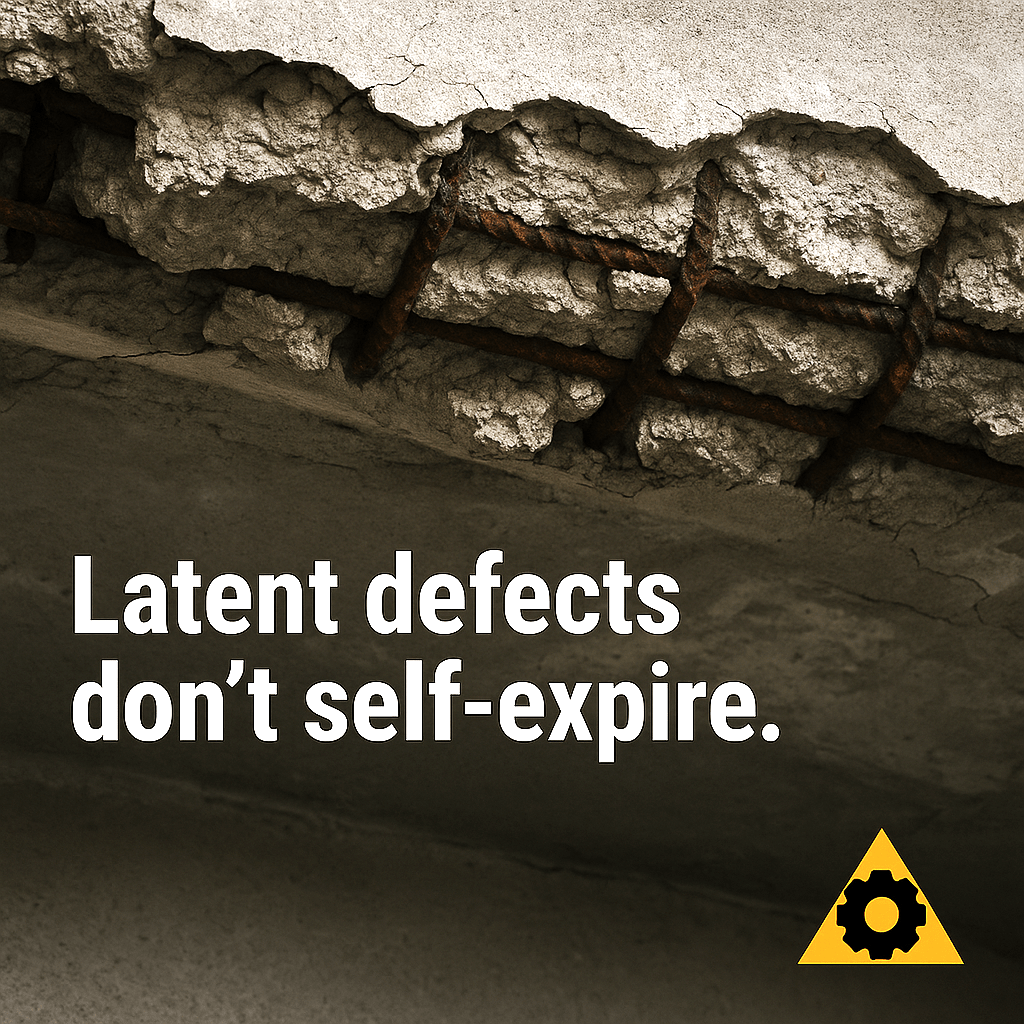
In the United Kingdom, a quiet crisis unfolded beneath school roofs and hospital ceilings. Reinforced autoclaved aerated concrete (RAAC) — once hailed as a modern building solution — began to fail. By 2023, hundreds of public buildings were found at risk of sudden collapse. Ceilings that looked fine hid structural weakness caused by age, moisture, and poor maintenance. Some schools had to close overnight. Others operated under emergency supports.
The UK Health and Safety Executive (HSE) urged every dutyholder to identify, assess, and manage RAAC as a structural safety risk. It wasn’t framed as an engineering issue — it was a workplace health and safety obligation. A structure is only safe if its integrity is verified, not assumed.
The RAAC crisis exposed a broader governance gap. Across the UK, many assets built between the 1950s and 1990s were designed with materials that have long exceeded their expected lifespan. Few organisations hold detailed records of what lies inside their walls, ceilings, and beams. Latent defects become legacy risks when documentation is missing and maintenance becomes reactive.
Australia faces similar challenges. Schools, hospitals, defence sites, and industrial facilities share the same ageing infrastructure profile. Under the Work Health and Safety Act 2011 (Cth), officers must ensure structural integrity risks are identified, monitored, and managed so far as is reasonably practicable. When oversight stops at the surface, unseen defects become foreseeable hazards.
Officer due diligence now means:
• Auditing legacy assets for materials and remaining life;
• Creating a Critical Elements Register covering load‑bearing components;
• Establishing inspection triggers tied to asset age and failure modes;
• Maintaining an Asset Integrity & Latent Defect Register — a ‘golden thread’ for physical infrastructure.
Length of service matters only when defects are known and controlled. Without data, years of safe operation are not proof of safety — only proof of luck.
Asset integrity is not a document but a system of verification. Boards should demand evidence of condition monitoring, external reviews, and governance oversight. When infrastructure fails, it’s not just concrete that collapses — it’s confidence in leadership.
#LetsTalkSafety #BookAConversation
References:
The Guardian. (2023). RAAC crisis: What is the concrete problem and where is it found? Available at: https://www.theguardian.com/education/2023/sep/01/raac-concrete-crisis-uk-schools
Health and Safety Executive (HSE). (2023). RAAC: Reinforced Autoclaved Aerated Concrete. Available at: https://www.hse.gov.uk/building-safety/raac.htm
Clyde & Co. (2023). Managing the RAAC crisis: Lessons for risk and governance. Available at: https://www.clydeco.com/en/insights/2023/09/managing-the-raac-crisis
Safe Work Australia. (2022). Model Work Health and Safety Act 2011 (Cth). Available at: https://www.safeworkaustralia.gov.au/law-and-regulation/model-whs-laws/model-whs-act