
Navigating a Hospital Procedure
Lessons Psychological safety can learn from checklists.

Contents
A Personal Encounter with a Medical Procedure.
Lessons from The Checklist Manifesto.
Psychological Safety: The Invisible Foundation.
Checklists and Psychological Safety: A Symbiotic Relationship.
Reflection on Psychological Safety During My Hospital Visit.
Beyond the Operating Room: Applications and Cautions.
Implications for Patient Advocates and Leaders.
Conclusion.
References.
When I walked through the sliding glass doors of my local hospital for a minor day procedure, I did not expect to come away with lessons that would reshape my views on checklists, safety culture and teamwork. In the days leading up to the procedure, I found myself anxious about the unknown—my mind replayed questions about the surgical process, the people involved and the possibility of something going wrong. Yet what struck me most was how ritualised and deliberate everything felt. Each nurse, anaesthetist and surgeon followed a script that balanced compassion with precision: identity checks, medication reconciliations, time‑outs and cross‑verification of allergies. It reminded me of Atul Gawande’s The Checklist Manifesto, a book I had reviewed a few months earlier, and how profoundly it speaks to reducing human error in complex environments.
This experience highlighted two key themes. First, checklists are not bureaucratic hurdles but cognitive safety nets that help teams navigate complexity and catch slip‑ups before harm occurs. Second, for checklists to be effective, healthcare teams must operate in an environment of psychological safety—a culture where everyone, regardless of status, feels comfortable speaking up about potential issues without fear of punishment. In this blog post, I reflect on the hospital visit, unpack lessons from The Checklist Manifesto and explore research showing that both checklists and psychological safety are vital for keeping people safe in high‑risk settings.
A Personal Encounter with A Medical Procedure
The morning of the procedure began in a pre‑admission waiting area. After completing the usual paperwork, a nurse escorted me to a small cubicle, handed me a gown and asked me to verify my name, date of birth and the nature of the procedure. She checked my allergies and confirmed when I last ate or drank. After each answer, she marked boxes on a printed form and occasionally consulted a tablet. Later, another nurse repeated the same questions, apologising for the repetition but explaining that it was critical to ensure everything matched across the electronic and paper records.
When the anaesthetist arrived, he introduced himself, confirmed my identity again and explained the planned anaesthetic. He reviewed my medical history and asked whether I had any loose teeth or prior reactions to anaesthesia. He then wrote notes on his own checklist. The surgeon arrived next, repeated the identity check and drew an arrow on the correct side of my body with a marker. Each step seemed deliberate and, at times, almost theatrical. Yet I realised this was part of a robust system of cross‑checks designed to catch the sort of human errors that can occur when clinicians work under time pressure and cognitive load.
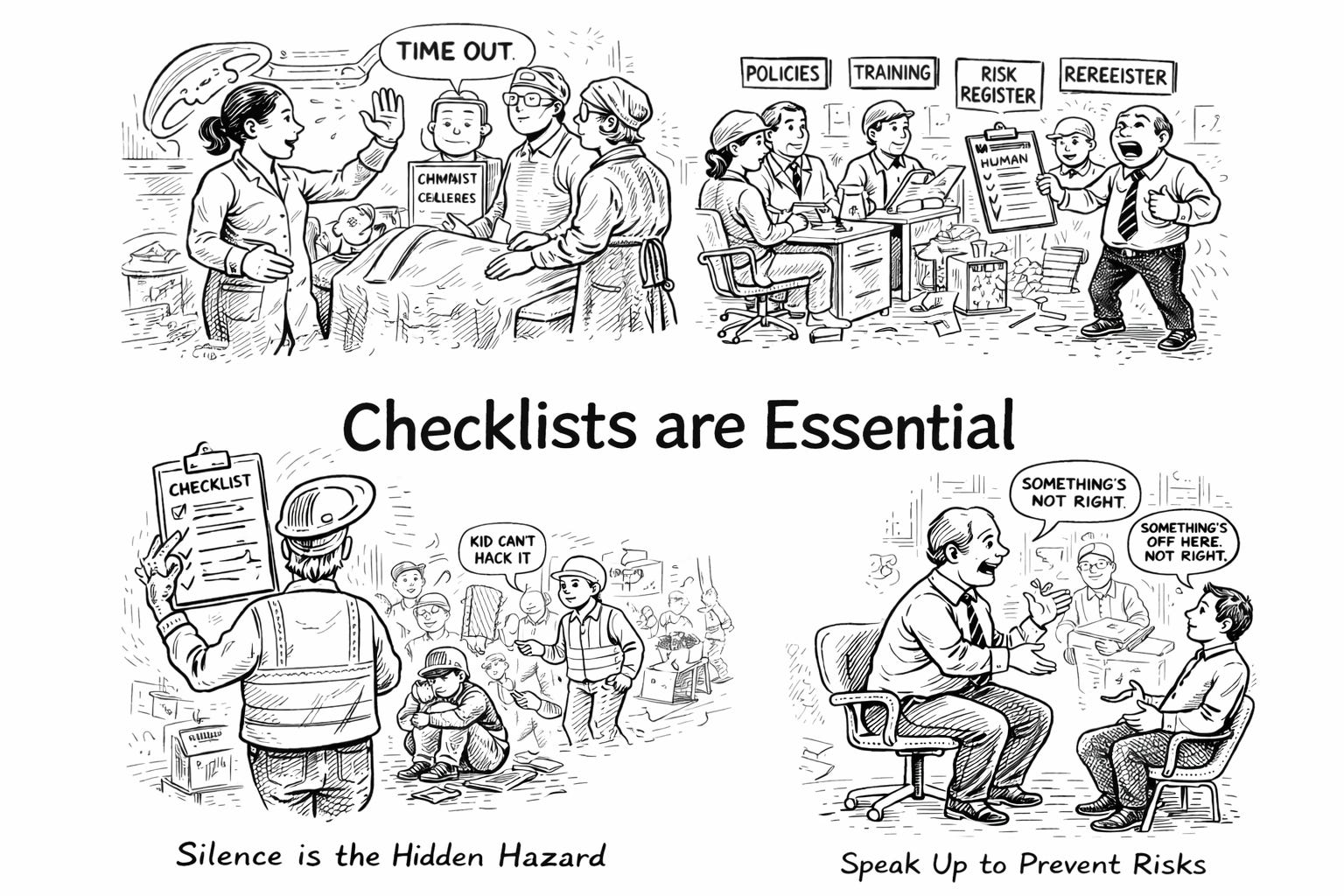
Before I was wheeled into the operating theatre, the team conducted what they called a time‑out—a final pause to review the procedure, confirm roles and ensure that everyone agreed on the plan. The nurse read from a checklist: “Patient name? Site marked? Allergies confirmed? Antibiotics administered? Equipment available?” Each answer required a verbal confirmation from the relevant team member. Only then did the surgeon announce, “Let’s begin.” Watching this process, I felt a surge of calm; even though I was the one lying on the table, I sensed that the team had created a safety net designed to catch mistakes before they reached me.
In the recovery room afterwards, I began to think about how these checklists had protected me. They were not simply boxes to tick but rather tools for structuring communication, ensuring that no critical step was overlooked and that any member of the team could voice concerns. They embodied the principles from The Checklist Manifesto, a book that argues human performance in complex tasks can be improved by simple, systematic aids.
Lessons from The Checklist Manifesto
Atul Gawande, a surgeon and writer, observed that modern tasks—whether in medicine, aviation or finance—have become so complex that individual expertise alone cannot guarantee reliable performance. He wrote that “the volume and complexity of what we know has exceeded our individual ability to deliver its benefits correctly, safely, or reliably”1. Gawande recounts stories where simple checklists prevented disaster: pilots landing damaged aircraft, builders erecting skyscrapers and surgeons performing intricate operations. The core idea is that checklists reduce cognitive load, leaving more room for situational awareness and problem‑solving.
Research supports Gawande’s claims. A report by the American Hospital Association notes that 88.8 % of quality leaders in a survey reported using checklists to prevent errors in operating rooms2. The same report explains that checklists “promote process improvement and increase patient safety” by standardising procedures, improving communication and reducing errors caused by missing information3. It also cites a World Health Organization surgical safety checklist implemented in eight hospitals around the world that resulted in a 36 % decrease in major post‑surgical complications and a 47 % reduction in deaths4. Those statistics are staggering—proof that a simple list of items, when embedded in the right culture, can save lives.
The impact of checklists is not limited to surgery. Peter Pronovost, a Johns Hopkins physician, developed a five‑step checklist to prevent central venous catheter infections. When this checklist was implemented at Johns Hopkins Hospital, the rate of line infections dropped from 11 % to 0 % over 27 months, preventing 43 infections and eight deaths, and saving US$2 million5. A broader rollout across 103 hospitals in Michigan reduced the infection rate by 66 %, saved an estimated 1,500 lives and US$175 million, and transformed Michigan’s ICU performance to outperform 90 % of hospitals nationwide6. These dramatic improvements resulted from a simple hygiene checklist combined with cultural changes encouraging anyone to speak up if they noticed noncompliance7.
Similar results are echoed in research compiled by the Agency for Healthcare Research and Quality (AHRQ). In discussing what makes a good checklist, AHRQ notes that checklists inspired by human factors psychology contributed to a surgical safety checklist that reduced deaths and complications by more than one‑third, and a catheter checklist that reduced bloodstream infections by up to 66 % in Michigan ICUs8. The article emphasises that well‑designed checklists must consider the task and the user—they need to be concise, include pauses for verification and be tailored to the real workflow9. Overly long or poorly designed checklists can impede performance or even create new risks10.
These findings resonate with Gawande’s argument that checklists should be performance‑oriented rather than compliance‑oriented. As the Psych Safety blog points out, when checklists become tools for bureaucratic compliance rather than performance, they can actually increase cognitive burden and diminish safety11. The key is to design checklists that free up mental bandwidth rather than stealing it, and to ensure that they evolve as tasks and environments change12.
Psychological Safety: The Invisible Foundation
While checklists provide structure and memory aids, they are only effective when people feel safe to use them properly. Psychological safety—a concept developed by Harvard professor Amy Edmondson—refers to the belief that one can speak up with ideas, questions or concerns without fear of embarrassment or punishment. In health care, where hierarchies are steep and stakes are high, psychological safety is both crucial and fragile.
A blog post by the Virginia Mason Institute describes psychological safety as “the shared belief that one can take interpersonal risks without fear of reprisal or judgment”13. It notes that psychological safety builds trust, promotes collaboration and innovation, and has direct impacts on patient outcomes14. In a psychologically safe environment, a nurse who notices a potential dosing error can speak up, preventing a serious adverse event15. The article emphasises that discussing errors without fear shifts the focus from blaming individuals to identifying and fixing systemic issues16.
The Yale School of Medicine explains that psychological safety means “one can speak up about ideas, issues, concerns or mistakes without fear of punishment, rejection or humiliation”17. It highlights that in high‑stakes health care settings, psychological safety allows teams to share vital information and address issues before they escalate, leading to better patient outcomes and a stronger workplace culture18. Benefits accrue at multiple levels: individuals experience improved well‑being and reduced stress; teams foster trust, discuss errors openly and enhance collaboration; and organisations see increased patient safety and job satisfaction19. The article also identifies barriers such as blame culture, lack of trust, fear of retaliation and power imbalances20—factors I could sense being deliberately countered in the time‑out rituals during my procedure.
Creating psychological safety requires leadership commitment. The Yale article suggests that leaders should “admit fallibility”, encourage open dialogue and thank team members for raising concerns21. These behaviours reinforce that it is acceptable—and expected—to voice potential problems. The Virginia Mason Institute similarly recommends equity pauses and structured team huddles that encourage everyone to voice different perspectives22. Such practices build trust and ensure that checklists are not just performed mechanically but serve as prompts for meaningful conversation.
Checklists and Psychological Safety: A Symbiotic Relationship
Checklists and psychological safety are often discussed separately, yet they reinforce each other. The Psych Safety article observes that well‑designed checklists can reduce anxiety and stress because they free cognitive capacity, allowing team members to concentrate on problem‑solving rather than memorising tasks23. The author lists situations where checklists are most useful: tasks that are repeatable, time‑pressured, distractible, critical to safety and performed by people who may not be experts24. These criteria certainly describe surgical procedures and ICU care.
The same article points out that when teams design and refine checklists collaboratively, the process itself enhances psychological safety25. Encouraging feedback from all team members acknowledges their expertise and signals that their voices matter. Conversely, having the psychological safety to admit that even an expert needs a checklist reduces stigma and encourages uptake26. By saying, “We expect mistakes—here is a tool to help,” leaders normalise human fallibility and invite open discussion about risk.
The Michigan central line initiative exemplifies this synergy. Implementation success depended not only on the checklist itself but also on empowering any member of the team—regardless of seniority—to stop a procedure if a step was missed7. As Atul Gawande wrote in The New Yorker, this protocol changed the culture: nurses could remind senior physicians to wash their hands or put on a sterile gown, and senior doctors accepted these reminders without resentment7. A culture of psychological safety turned the checklist from a piece of paper into a powerful tool.
Reflection on Psychological Safety During My Hospital Visit
During my procedure, I noticed small interactions that demonstrated psychological safety in action. When the scrub nurse asked the surgeon if the antibiotic dose had been administered, she did so with confidence and without hesitation. The surgeon, in turn, responded without irritation. When the anaesthetist clarified my allergy list for the third time, he apologised for the repetition but emphasised its importance. At one point, a junior nurse corrected the equipment set‑up, prompting a brief discussion that resulted in repositioning a monitor. There was no defensiveness—only a shared recognition that catching a potential issue was part of the job.
As a patient, these moments reassured me. Even though I did not know the staff personally, the way they communicated conveyed that the team valued safety over hierarchy. It reminded me of my own workplace, where psychological safety often determines whether we speak up when something feels wrong. Without that safety, checklists could become mindless rituals devoid of meaning or, worse, tools for blaming individuals after the fact.
Beyond the Operating Room: Applications and Cautions
The principles I observed apply well beyond health care. In aviation, checklists guide pilots through take‑off, landing and emergency procedures—situations where small omissions can lead to catastrophe. The Checklist Manifesto recounts the story of the B‑17 bomber prototype that crashed during its maiden flight because the pilot was overwhelmed by complexity; after introducing a checklist, the aircraft went on to accumulate an excellent safety record27. Similarly, event managers use checklists to prepare for large concerts, ensuring that doors open safely and emergency plans are in place28.
Checklists also feature in industries like construction, where project managers coordinate hundreds of tasks and subcontractors. However, as the Psych Safety article warns, checklists must remain performance tools rather than compliance tools11. Overly rigid or poorly designed checklists can foster a false sense of security, encourage “checklist fatigue” and even harm outcomes29. Surgeons have expressed frustration when inundated with multiple checklists, joking they need a checklist for all their checklists29. Usability matters: font size, spacing, clarity and length influence whether a checklist helps or hinders9.
Psychological safety also has limits. It does not mean lowering standards or avoiding accountability. Instead, it involves setting high performance expectations alongside openness: acknowledging fallibility while remaining committed to excellence. In health care, this means encouraging staff to report near misses, learn from errors and continually refine processes. Leaders must model vulnerability, respond constructively to feedback and avoid creating cultures of fear or blame.
Implications for Patient Advocates and Leaders
From a patient’s perspective, my experience underscores the importance of advocating for processes that support safety. Patients and their families can feel more secure knowing that hospitals implement checklists and encourage staff to speak up. If you are preparing for a procedure, do not hesitate to ask whether your hospital uses a surgical safety checklist or encourages team time‑outs. Recognising these practices can improve your confidence and may even influence hospitals to sustain or expand them.
For health care leaders, the evidence demands action. Implementing checklists requires investment in training, monitoring and culture change, but the returns are clear: fewer complications, lives saved and cost savings measured in millions6. Building psychological safety requires intentional leadership behaviours—creating shared meaning, soliciting input, admitting fallibility and rewarding courage21. These behaviours cannot be mandated through policy alone; they must be modelled daily by senior clinicians and administrators.
Conclusion
My minor hospital procedure became a lesson in the power of simple tools and supportive cultures. The checklists I witnessed were not bureaucratic checkmarks but lifelines that structured communication and ensured no step was missed. They embodied the core message of The Checklist Manifesto—that in our increasingly complex world, humility and discipline are as essential as knowledge. Psychological safety provided the environment in which those checklists could flourish; nurses could correct doctors, juniors could ask questions, and everyone felt responsible for catching potential errors. Together, checklists and psychological safety create a safety net that catches human fallibility before it reaches the patient.
High‑risk environments—whether in hospitals, cockpits or construction sites—demand systems that recognize human limitations and encourage open communication. My experience reinforced that following procedure is not mere bureaucratic drudgery but a profound act of care and respect. By embracing both systematic checklists and cultures of psychological safety, we can continue to reduce errors, improve outcomes and build organisations where people feel safe to do their best work.
References
Gawande, A. (2010). The Checklist Manifesto: How to Get Things Right. Metropolitan Books.
Health Research & Educational Trust. (2013). Checklists to Improve Patient Safety. American Hospital Association.
Available at: https://www.aha.org/system/files/hpoe/Reports-HPOE/CkLists_PatientSafety.pdfPronovost, P., et al. (2006). Keystone ICU Project: Reducing central line infections. Johns Hopkins University.
Agency for Healthcare Research and Quality. (2010). What Makes a Good Checklist.
Available at: https://psnet.ahrq.gov/perspective/what-makes-good-checklistGeraghty, T. (2023). Psychological Safety: Checklists. Psych Safety.
Available at: https://psychsafety.com/psychological-safety-checklists/Virginia Mason Institute. (2024). Fostering Healing Environments: The Role of Psychological Safety in Healthcare.
Available at: https://www.virginiamasoninstitute.org/fostering-healing-environments-the-crucial-role-of-psychological-safety-in-healthcare/Yale School of Medicine. (2025). The Power of Psychological Safety in Health Care Teams.
Available at: https://medicine.yale.edu/news-article/psychological-safety-in-health-care-teams/Healthcare in Europe. (2022). Simple checklists could save healthcare billions.
Available at: https://healthcare-in-europe.com/en/news/simple-checklists-could-save-healthcare-billions.html
1 2 3 4 Checklists to Improve Patient Safety
https://www.aha.org/system/files/hpoe/Reports-HPOE/CkLists_PatientSafety.pdf
5 6 7 Simple checklists could save healthcare billions • healthcare-in-europe.com
https://healthcare-in-europe.com/en/news/simple-checklists-could-save-healthcare-billions.html
8 9 10 What Makes a Good Checklist | PSNet
https://psnet.ahrq.gov/perspective/what-makes-good-checklist
11 12 23 24 25 26 27 28 29 30 Psychological Safety: Checklists - Psych Safety
https://psychsafety.com/psychological-safety-checklists/
13 14 15 16 22 31 The Crucial Role of Psychological Safety in Healthcare | Virginia Mason Institute
17 18 19 20 21 32 33 The Power of Psychological Safety in Health Care Teams | Yale School of Medicine
https://medicine.yale.edu/news-article/psychological-safety-in-health-care-teams/