
LEAD: Building Leadership Capacity for Psychosocial Risk Governance
Pre-Event Psychosocial Risk Management Framework 5

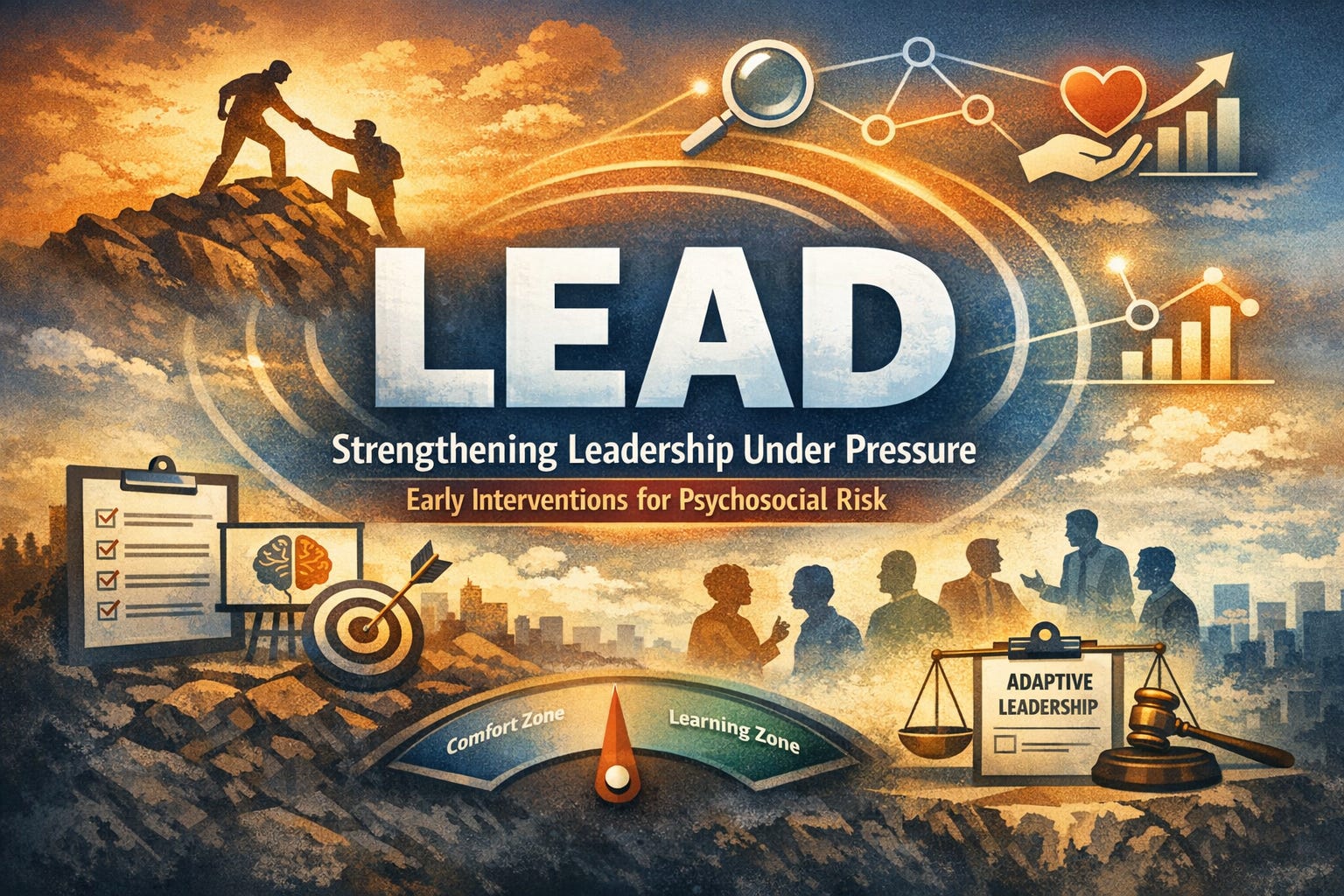
Why leadership matters
Psychosocial hazards seldom appear out of nowhere.
They accumulate through unchecked workload pressure, unresolved conflicts and silent suffering.
In high‑risk environments – hospitals, mines, manufacturing plants, corporate offices – the difference between healthy teams and burnout often lies in leadership.
Australian WHS legislation and ISO 45003 require officers and managers to ensure resources and processes are in place for psychological health and safety.
Yet compliance on paper is not enough.
Incidents continue to arise because leaders may not detect weak signals, may not know how to respond or may not understand how their own behaviour shapes culture.
The LEAD framework helps fill this gap.
It is a proactive model for managers and supervisors that translates research, regulatory requirements and crisis management lessons into practical actions.
By focusing on commitment and culture, capability, sense‑making, adaptive leadership, inclusiveness and learning, LEAD equips organisations to prevent psychosocial harm before it escalates.
What LEAD stands for
1. Commitment and positive culture
Leadership sets the tone.
The Western Australian Code of Practice on psychosocial hazards stresses that managers and supervisors must create a positive workplace culture, understand their WHS obligations and model appropriate behaviour.
Visible commitment – investing time, resources and attention in psychological health – signals that wellbeing matters as much as productivity.
This includes encouraging early reporting, treating workers fairly and avoiding punitive approaches that compound stress.
Psychosocial risk management is not a “bolt‑on” program but a leadership responsibility.
2. Knowledge and capability
Good intentions are insufficient if leaders lack skills.
The Code of Practice notes that managers must have the knowledge and support to identify and address psychosocial hazards, communicate effectively and provide tailored assistance to workers.
Training in psychosocial risk factors, stress responses and mental health first aid equips supervisors to intervene early.
Building capability also means understanding the legal landscape – WHS duties, due‑diligence requirements and the business case for psychological safety.
When leaders know the “why” and “how”, they can act decisively rather than waiting until injuries or claims occur.
3. Sense‑making and scanning
Traditional safety indicators such as injury rates and compensation claims are lagging indicators – they describe failure after harm has occurred.
To prevent psychosocial harm, leaders must scan for leading indicators: escalating workloads, reduced participation, spikes in absenteeism, rising turnover, increasing complaints or tensions within teams.
Strategic crisis‑management research highlights the importance of sense‑making – gathering diverse information, detecting silences and omissions, and encouraging “managed diversity” of perspectives.
High‑reliability organisations empower employees to identify problems and decentralise authority so decisions can be made by those closest to the issue[4].
For leaders, this means listening to informal concerns, watching for behavioural changes and encouraging reporting.
These signals allow early intervention before stress becomes injury.
4. Adaptive leadership
Not all problems have ready‑made solutions.
Adaptive challenges – such as toxic culture, unrealistic workloads or conflicting priorities – require experimentation, learning and behavioural change.
Ronald Heifetz and colleagues distinguish adaptive challenges from technical problems and propose an “observe, interpret, intervene” cycle to navigate complexity.
Adaptive leadership involves sharing the work of problem solving, acknowledging uncertainty and inviting staff to co‑design solutions.
Leaders must hold a productive level of tension – enough to motivate change but not so much that it overwhelms.
In psychosocial risk management, adaptive leadership means recognising that policies or training alone will not fix deep‑seated issues.
Supervisors should be prepared to change their own behaviours, adjust workloads and redesign processes.
5. Inclusiveness and empathy
Trust and psychological safety flourish when leaders are authentic, benevolent and empathetic.
An evidence review by the CIPD found that psychological safety depends on organisational climate, leadership and people‑management practices.
Leaders build trust by giving autonomy, sharing power and involving employees in decisions.
Practical recommendations include embracing mistakes as learning opportunities, paying attention when listening and leading by example – sharing your own uncertainties and acknowledging errors.
These behaviours signal respect, reduce fear and encourage open communication.
Without psychological safety, workers will not report hazards or suggest improvements, and early warning systems will fail.
6. Learning and accountability
Crisis management does not end when a problem is resolved.
Boin et al. emphasise accounting and learning as core leadership tasks: analysing what worked, what failed and how systems can improve[3].
In psychosocial risk governance, leaders should conduct after‑action reviews, collect feedback from surveys and incident reports, and adjust controls accordingly.
A just culture balances accountability and learning so people feel safe to report mistakes.
Boards and executives must integrate psychosocial metrics into governance processes – tracking early‑warning indicators, survey scores and leadership training outcomes – and hold themselves accountable for improvements.
Case examples
Rebuilding a toxic workshop
A Western Australian automotive workshop faced multiple psychosocial hazards: poor leadership, confusing policies, unclear roles and harsh environmental conditions.
Workers experienced inconsistent treatment, unclear expectations and unsafe noise and heat levels.
Applying the LEAD principles, the organisation implemented consultative leadership (seeking worker input), developed fair policies, clarified roles and invested in ventilation and noise control.
By involving workers in decisions and addressing both leadership and environmental issues, the workshop rebuilt trust, reduced stress and improved morale.
Transforming a government department
A large state government department suffered from poor leadership and low morale.
Employees cited inadequate support, recognition and change management.
Senior leaders adopted LEAD behaviours: they developed a mentally healthy workplace strategy, coached managers, provided diversity and inclusion training, integrated psychosocial KPIs into performance reviews, implemented fair policies and structured change management, and reinforced flexible work practices.
Trust and engagement improved as leaders demonstrated commitment, built capability, involved staff and learned from feedback.
Adaptive leadership in healthcare crises
During the COVID‑19 pandemic, healthcare executives had to make decisions amid uncertainty and evolving guidance.
Hospitals that embraced psychological safety by framing the crisis as a learning challenge, inviting participation and responding constructively were better able to innovate and maintain staff morale.
Harvard Business publications note that effective leaders frame work as a learning opportunity, invite diverse perspectives and respond productively to feedback.
These behaviours mirror LEAD – they enable sense‑making, adaptive responses and continuous improvement.
Putting LEAD into practice
Implementing LEAD requires deliberate action:
Educate leaders. Provide training on psychosocial hazards, adaptive leadership, psychological safety and crisis management. Ensure managers know their legal obligations and the organisation’s psychosocial risk policies.
Establish scanning routines. Create systems for leaders to review early‑warning dashboards, incident reports, grievances, exit interviews and informal feedback. Encourage managers to spend time on the front line, listening and observing workloads. Cross‑functional teams can interpret signals and avoid groupthink.
Empower decision‑making close to the problem. Decentralise authority so supervisors can act immediately when psychosocial hazards emerge. Provide clear escalation pathways for issues beyond their control. High‑reliability organisations show that decentralisation improves crisis response.
Model empathy and authenticity. Leaders should share their own challenges, acknowledge uncertainty and show they value employee wellbeing. Recognise and reward workers who speak up about hazards. Involve employees in designing solutions[7].
Create learning loops. After interventions, hold debriefs to explore successes and failures. Document lessons and adjust policies, training and controls accordingly. Use feedback from psychosocial safety climate (PSC) surveys and early‑warning dashboards to track improvements and identify new risks.
Integrate psychosocial metrics into governance. Include psychosocial risk measures in board packs and leadership performance reviews. Boards should expect heatmaps of PSC scores, early‑warning indicator breaches and progress on leader training and controls. What gets measured gets governed.
Conclusion
Strong leadership is the keystone of psychosocial risk prevention.
By committing to positive culture, building capability, scanning for weak signals, embracing adaptive leadership, practising inclusiveness and learning from experience, organisations can fulfil their WHS duties and protect their people.
The LEAD framework translates evidence and regulations into practical actions.
When leaders demonstrate empathy, listen actively and act swiftly on early warnings, they prevent harm and unlock innovation and engagement.
Case studies show that leadership behaviours – whether consultative or punitive – dramatically influence psychosocial outcomes.
Investing in LEAD equips organisations to navigate uncertainty, meet due‑diligence obligations and create healthy, high‑performing teams.
References
1. Government of Western Australia. (2022). Managing psychosocial hazards at work: Code of practice. Department of Mines, Industry Regulation and Safety. Available at: https://www.worksafe.wa.gov.au/sites/default/files/atoms/files/221154_cp_psychosocialhazards.pdf
2. Boin, A., ’t Hart, P., Stern, E., & Sundelius, B. (2016). The politics of crisis management: Public leadership under pressure (2nd ed.). Cambridge University Press.
3. Boin, A., ’t Hart, P., Stern, E., & Sundelius, B. (2016). Notes on crisis leadership and sense-making. Summary available at: https://forum.effectivealtruism.org/posts/fhWiQZbajwy8piuve/notes-on-the-politics-of-crisis-management-boin-et-al-2016
4. Heifetz, R., Grashow, A., & Linsky, M. (2009). The practice of adaptive leadership: Tools and tactics for changing your organization and the world. Harvard Business Press.
5. Chartered Institute of Personnel and Development (CIPD). (2024). Trust and psychological safety: An evidence review – Practice summary and recommendations. Available at: https://www.cipd.org/globalassets/media/knowledge/knowledge-hub/evidence-reviews/2024-pdfs/8542-psych-safety-trust-practice-summary.pdf
6. Bonterre, M. (2025). Why psychological safety is the hidden engine behind innovation and transformation. Harvard Business Impact. Available at: https://www.harvardbusiness.org/insight/why-psychological-safety-is-the-hidden-engine-behind-innovation-and-transformation/