
CREW: Civility as a Psychosocial Risk Control
Pre-Event Psychosocial Risk Management Framework 10

Executive summary
If you want psychosocial risk management to survive board scrutiny, you need controls that are observable, repeatable, and measurable. The CREW program—Civility, Respect and Engagement in the Workplace—is one of the few structural, team-based interventions with a long implementation record and a measurable climate tool.
In Australia, incivility is not “soft culture stuff.” It is an early warning signal that can escalate into bullying and other harmful behaviors, and regulators increasingly treat harmful behaviors as psychosocial hazards requiring risk management.
CREW is defensible because it operates like a control mechanism:
It targets workgroup norms (the “rules of engagement” people actually follow).
It uses structured, facilitated sessions over time (not one-off training).
It measures baseline and change (using a civility scale) and supports action planning.
For boards and executives, CREW is valuable because it aligns directly with:
the duty to ensure workers are not exposed to risks to psychological health so far as reasonably practicable (Model Code framing),
officer due diligence under WHS Act s27 (resources, systems, reporting, consultation, verification),
ISO 45003:2021 principles about leadership, culture, communication, and integrating psychosocial risk into an OH&S management system.
This article explains CREW’s theory and evidence, provides two detailed case studies, gives a step-by-step Australian implementation playbook with KPIs, and recommends a Substack-native citation style that stays credible for regulators and litigators.
Background and why this matters in Australia
Australia’s psychosocial risk agenda is being dragged forward by data and law—regardless of whether leaders feel “ready.”
The cost profile is board-level
Safe Work Australia reports that mental health conditions accounted for 12.0% of serious claims (17,600) in 2023–24p, with median time lost 35.7 weeks and median compensation $67,400—far beyond “normal” claim severity. This isn’t a wellbeing KPI. It’s an enterprise risk indicator.
The legal expectation is clear
Safe Work Australia’s psychosocial model Code defines psychosocial hazards as hazards arising from the design or management of work, the working environment, plant, or workplace interactions/behaviours, and notes they may cause psychological and physical harm.
It also states that a PCBU must ensure workers are not exposed to risks to their psychological or physical health and safety, and must eliminate risks (or minimise them) so far as reasonably practicable.
This is why CREW matters: harmful behaviors are psychosocial hazards, and the “social glue” of civility is a control mechanism that reduces hazard escalation.
Incivility is an early warning signal, not a minor annoyance
Safe Work Australia’s Harmful Behaviours report describes harmful behaviors as ranging on an escalating scale “from incivility to bullying and physical violence,” and notes that witnessing incivility and bullying can lead to negative health outcomes and increased likelihood of becoming an initiator of incivility.
The report explicitly frames incremental increases in incivility as predicting more intense harmful behaviors, making incivility an early warning sign that must be managed to reduce escalation.
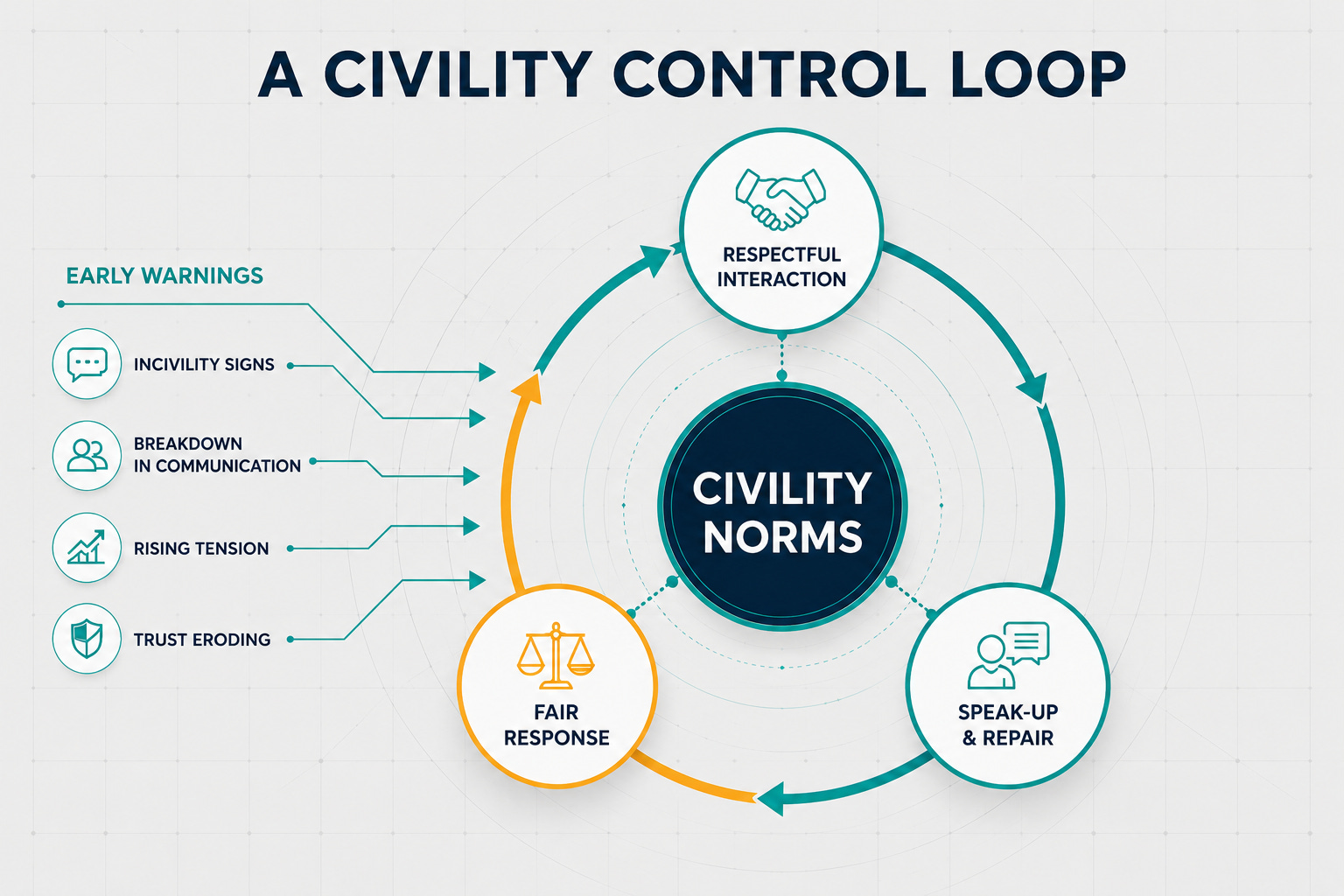
If RADAR is your early detection system, CREW is what you deploy when RADAR tells you the interpersonal climate is degrading.
CREW explained: what it is, why it works, and where it fits ISO 45003
CREW is a structured, facilitated workgroup intervention designed to strengthen civility norms and respectful interaction—before issues escalate into bullying, harassment, and psychological injury.
What CREW is, in plain terms
A U.S. Federal Occupational Health overview describes CREW as a culture change initiative launched by the United States Department of Veterans Affairs in 2005 and used by over 1,200 VA workgroups.
The same source defines:
Civility as courteous, considerate behavior,
Respect as deep listening, understanding, and creating a safe place for difficult conversations,
Engagement as the result of respectful relationships in an atmosphere of trust, enabling staff to make decisions “on the spot.”
That definition set is important for WHS: CREW is explicitly built to improve the conditions under which people speak up, cooperate, and solve problems.
How CREW works operationally
CREW is not a “training session.” It is repeated practice.
Facilitators meet regularly with selected workgroups for about six months, using voluntary meetings to allow workgroup-level conversations about civility and the work environment, and to practice new behaviors that can become cultural norms.
CREW doesn’t look identical everywhere; the FOH summary states there is “no manual,” but it is structured similarly: each site identifies a coordinator, facilitators, and participating workgroups.
From an ISO 45003 perspective, that structure maps neatly to:
participation and consultation,
competence (facilitator capability),
operational planning and control,
performance evaluation and continual improvement.
Why CREW is a psychosocial control, not a “culture initiative”
Safe Work Australia’s Harmful Behaviours report notes incivility has three characteristics: norm violation, ambiguous intent, and low intensity, distinguishing it from other harmful behaviors.
Those characteristics make typical compliance controls weak:
You can’t “prove intent” easily.
One-off incidents look small.
Managers downgrade it until it escalates.
CREW tackles the only thing that reliably stops escalation: workgroup norms and the everyday behavioral baseline people accept as normal.
Where CREW fits ISO 45003 and the psychosocial risk hierarchy
ISO’s own explainer on ISO 45003 notes the standard gives guidance on managing psychological health and safety risks within an OH&S management system, addressing areas affecting psychological health including ineffective communication, excessive pressure, poor leadership, and organisational culture.
In other words: CREW sits in the “social factors and leadership behaviors” control family, and supports higher-order controls by improving the conditions for:
genuine consultation,
early reporting,
respectful conflict resolution,
fair and consistent response to issues.
CREW is not sufficient on its own. It is a control amplifier—it increases the effectiveness of your existing WHS systems by improving social conditions that enable hazards to be surfaced and managed.
Evidence base: what we know, what we don’t, and why CREW is still worth it
The test for a board-facing intervention is not “do people like it?” The test is:
does it measurably shift risk-relevant conditions,
does the shift plausibly reduce harm,
is it implementable at scale without collapsing into performative behavior?
The broader evidence on civility and harm is strong
Australian research is increasingly explicit that incivility is not just unpleasant; it is safety-relevant.
A systematic review and meta-analysis led by Freedman (James Cook University) concludes that incivility is prevalent in tertiary hospitals and has a deleterious effect on patient safety culture and outcomes.
That matters for WHS governance: if incivility degrades safety culture and outcomes in high-reliability settings, it is not a “people issue.” It is a system condition that requires structured control.
Safe Work Australia’s Harmful Behaviours report backs this causal framing: incivility spirals can intensify exchanges and increase acceptance of disrespect, eroding social norms and degrading culture—raising frequency, duration, and intensity of harmful behaviors.
This is why CREW is useful in a pre-event series: it intervenes early in the escalation chain.
What evidence exists on CREW specifically
Two “hard” strengths of the CREW evidence are:
it is structured and sustained in delivery (months, not hours), and
it has a validated measurement instrument (the CREW Civility Scale) with established reliability and construct validity.
A 2022 open access validation study of the eight-item CREW Civility Scale found strong internal consistency (Cronbach’s alpha 0.93) and that civility scores were positively correlated with supervisor support, coworker support, and work engagement, and negatively correlated with incivility, workplace bullying, intention to leave, and psychological distress.
This is useful in governance terms: you can measure civility as a leading indicator, linked to multiple risk-relevant outcomes.
What recent implementation research implies
A 2023 realist review of interventions to address unprofessional behavior in acute care identifies “structured culture change interventions” and explicitly includes CREW as a flexible package enabling organisations to respond as needed, building on ongoing action planning and surveys to understand prevalence and spread.
The same review is blunt about trade-offs: flexibility can increase effectiveness across contexts, but it can reduce fidelity because different components may be used across sites, complicating evaluation.
That’s a governance warning: CREW must be implemented with minimum standards and documentation, or it becomes unmeasurable.
Case study 1: VA-scale CREW implementation
Context
CREW originated within the U.S. Department of Veterans Affairs and scaled across over 1,200 workgroups.
The trigger was culture and satisfaction data—workers reporting poor civility impacting the work environment (as described in VA materials).
Design
A trained facilitator runs regular, voluntary workgroup meetings for around six months, using structured activities and problem-solving to improve relationships and practice new behaviors that become norms.
Leadership support is not optional. The FOH overview lists practical support actions: dedicating time for participation, providing budget for small meeting items, maintaining communication with coordinators/facilitators, and providing visible support across the organisation.
Measured outcomes and reported business case
The FOH overview claims (as correlations/associations reported in “research suggests”) that higher civility is linked to reduced complaints, reduced sick leave, increased patient and employee satisfaction, higher retention, and better productivity.
Treat this cautiously: it’s a summary document, not a peer-reviewed causal estimate. But it provides a governance narrative boards can use: civility is linked to risk and performance outcomes worth controlling.
What makes this defensible in Australia
It is a structured, repeated intervention (not a lecture).
It requires leadership resourcing and visible support.
It explicitly states CREW is not a substitute for good supervision, and not a quick fix for a troubled team.
Case study 2: CREW in a Japanese psychiatric ward (pilot evaluation)
Context
A 2021 pilot study examined CREW in a Japanese psychiatric ward, focusing on social climate and work engagement.
The study describes 18 sessions over six months, each 30 minutes, recommended to all staff but not mandatory.
Evaluation and results
The study reported no statistically significant effects overall, but did report effect sizes (e.g., EssenCES effect size 0.35 overall; larger subgroup effect sizes for some staff groups).
It also had operational constraints: staff composition changed over time due to rotation, and the design used serial cross-sectional data across four time points.
Why this still matters
This is exactly the kind of “real-world mess” WHS leaders face: rotating rosters, churn, and imperfect conditions. The study is a practical reminder that CREW effectiveness is not automatic; it requires stable conditions, participation, and enough runway for norms to embed.
Australian governance takeaway
Don’t sell CREW as a guaranteed outcome generator. Sell it as a structured control that improves the probability of:
earlier detection of deteriorating norms,
better communication and engagement,
fewer escalation pathways into bullying and formal complaints.
Governance and legal defensibility under Australian WHS and ISO 45003
If you want CREW to be board-approved and regulator-ready, you must frame it properly: CREW is a psychosocial risk control aimed at harmful behaviors, not a values project.
WHS law anchors: primary duty, consultation, and risk management
The Safe Work Australia psychosocial Code defines psychosocial hazards and explicitly links them to work design/management, environment, and workplace interactions/behaviours.
It also lists harmful behaviors such as bullying and violence/aggression as psychosocial hazards, defining bullying as repeated unreasonable behavior creating a risk to health and safety.
Consultation is a legal requirement, not a “nice to have.” The Code states PCBUs must consult with workers when assessing psychosocial risks and making decisions about control measures.
CREW supports consultation by providing a structured, facilitated mechanism for workgroup-level dialogue and problem-solving—one of the hardest things to do safely when incivility is already present.
Codes of Practice: the court-facing reality
Safe Work Australia’s model Code states inspectors may refer to an approved code of practice when issuing notices.
Courts may treat Codes as evidence of what is known about hazards, risks, and controls and what is reasonably practicable.
So, if your organisation is experiencing escalating incivility and you have nothing structured in place beyond “zero tolerance posters,” you are in a weak position.
Officer due diligence: why boards have to care
The Safe Work Australia guide to the model WHS Act states officers must exercise due diligence and describes it as relating to strategic, structural, policy, and key resourcing decisions (“how the place is run”).
It then lists due diligence steps including ensuring resources and systems exist and are used, ensuring processes for receiving and responding to hazard information exist, and verifying those resources and processes.
The officer interpretive guideline expands these into a structured list (knowledge, understanding operations and hazards, resources, reporting and response, compliance processes, and verification).
CREW supports due diligence in two direct ways:
It strengthens the organisation’s ability to receive and consider information about interpersonal hazards early (before they become formal complaints or injuries).
It creates evidence of resourcing and process (facilitator training, scheduled sessions, action plans, evaluation).
ISO 45003 alignment: why it matters even without certification
ISO’s explainer states ISO 45003 addresses factors that impact psychological health including communication, pressure, leadership, and culture.
Standards Australia’s summary notes AS/NZS ISO 45003 is designed to align psychosocial risk management with existing OH&S systems based on ISO 45001 and highlights the need to understand psychosocial hazards interacting with other hazards.
CREW fits ISO 45003 as a social control mechanism under leadership and culture, worker participation, and performance evaluation.
Implementation playbook, KPIs, and phased timeline
Here’s the hard truth: CREW fails when it’s treated like “team building.” It succeeds when it’s treated like a structured WHS control with governance, resourcing, and measurement.
Step-by-step implementation
1. Set scope and governance
CREW should sit inside the organisation’s psychosocial risk management strategy, not inside a generic culture or values initiative. That distinction matters. Once CREW is framed as a “culture program,” organisations often stop treating it as a measurable WHS control and start treating it as an engagement exercise.
The better approach is to position CREW as a structured psychosocial risk control aimed at reducing harmful workplace behaviours before they escalate into bullying, psychological injury, grievances, or formal conflict.
This means linking CREW directly to:
psychosocial risk register entries;
harmful behaviour indicators;
interpersonal conflict trends;
bullying and incivility reports;
psychosocial hazard reviews, and
officer due diligence reporting.
From a governance perspective, boards and executives should be able to answer three questions clearly:
Why are we implementing CREW?;
Which psychosocial risks is it intended to control?; and
How will we know whether it is working?
If those questions cannot be answered, CREW risks becoming another short-lived “people initiative” disconnected from operational risk management.
2. Choose workgroups strategically
CREW is not designed as an emergency intervention for highly dysfunctional teams already in crisis. The Federal Occupational Health (FOH) guidance is explicit on this point. CREW works best where there is enough stability, participation, and leadership support for behavioural norms to gradually shift over time.
In practice, the most suitable groups are those:
experiencing early signs of interpersonal strain;
showing declining communication or trust;
reporting low psychological safety;
struggling with collaboration or escalation fatigue;
undergoing operational change, or
displaying emerging incivility patterns before formal complaints escalate.
CREW is far less effective when organisations attempt to use it as a substitute for:
misconduct management;
formal investigations;
performance management;
supervision failures, or
chronic workload and resourcing problems.
If a team is already overwhelmed, unsafe, or under formal investigation, introducing CREW too early can backfire. Workers may interpret the process as avoidance, minimisation, or organisational image management rather than genuine risk control.
Before implementation, organisations should therefore assess:
workload pressures;
leadership capability;
team stability;
psychological safety levels;
ongoing investigations or grievances, and
operational readiness for participation.
CREW works best when deployed proactively, not reactively.
3. Build facilitation capability
CREW is heavily facilitator-dependent. The quality of facilitation often determines whether sessions become constructive behavioural interventions or deteriorate into frustration, blame, and disengagement.
Poor facilitation typically creates one of two outcomes:
unstructured grievance dumping with no accountability or direction; or
superficial “forced positivity” that workers perceive as inauthentic.
Both outcomes damage trust and reduce the credibility of psychosocial risk programs.
Facilitators therefore require more than workshop presentation skills. They need capability in:
psychological safety practices;
respectful conflict management;
group dynamics;
active listening and de-escalation;
maintaining neutrality;
managing emotionally charged discussions;
recognising psychosocial hazards and escalation indicators, and
distinguishing between CREW discussions and formal investigative processes.
Importantly, facilitators must understand that CREW is not therapy, mediation, or an investigation. Boundaries must remain clear.
Organisations should also establish escalation pathways for situations where discussions reveal:
bullying allegations;
psychological injury risks;
safety concerns;
misconduct indicators, or
threats to worker wellbeing.
Without these safeguards, CREW can unintentionally surface risks without having systems in place to manage them properly.
4. Run the sustained intervention
CREW is designed as a repeated behavioural intervention delivered over time. It is not a single workshop, toolbox talk, or awareness session.
Research and implementation experience consistently show that behavioural norms change through repetition, reinforcement, and practice rather than one-off exposure.
Most CREW implementations operate across approximately six months using regular facilitated sessions. The Japanese CREW pilot, for example, delivered 18 sessions over six months. That provides a useful operational benchmark because it reflects “dose-response” thinking commonly used in behavioural and organisational interventions.
This matters because many organisations underestimate the time required for trust rebuilding and norm stabilisation.
A one-hour civility workshop is not CREW.
For implementation integrity, organisations should establish:
minimum session frequency;
attendance expectations;
facilitation standards;
documentation protocols;
action tracking requirements, and
evaluation checkpoints.
Consistency matters more than intensity. Short, regular, psychologically safe conversations sustained over time are more effective than occasional large-scale workshops disconnected from operational reality.
5.Translate discussions into operational controls
One of the biggest implementation failures occurs when CREW conversations remain purely reflective or emotional without translating into operational change.
CREW should generate practical outputs that can be governed, monitored, and verified.
Examples include:
team behavioural agreements and norms;
agreed escalation pathways;
conflict response expectations;
communication protocols;
meeting conduct standards;
role clarification actions;
manager behavioural commitments;
workload review triggers, and
agreed “if-then” responses for predictable interpersonal risks.
The 2023 realist review on interventions for unprofessional behaviour highlighted the importance of ongoing action planning and structured follow-through. Conversations alone rarely change systems. Action ownership does.
Each identified improvement action should therefore include:
a responsible owner;
implementation timeframe;
review point;
success measure, and
escalation pathway if unresolved.
This is the point where CREW moves from “discussion” into genuine psychosocial risk control.
6. Embed CREW into organisational systems
Without system integration, behavioural gains decay quickly. Teams often revert to old interaction patterns once facilitation stops if expectations are not reinforced operationally.
To sustain impact, CREW outcomes should be integrated into existing organisational systems, including:
induction and onboarding;
leadership development;
supervisory capability programs;
psychosocial risk reviews;
team performance discussions;
complaint management systems;
bystander response processes;
worker consultation mechanisms, and
continuous improvement reviews.
Embedding also strengthens legal defensibility. Regulators and courts are more likely to view CREW as a credible control where it is visibly integrated into broader WHS governance systems rather than operating as a standalone wellbeing activity.
The goal is not to create a separate civility program.
The goal is to strengthen the behavioural conditions under which safe work, consultation, escalation, and psychosocial risk management occur.
Metrics and KPIs that boards will actually accept
Boards rarely respond well to vague statements about culture improvement. They need measurable indicators that demonstrate whether psychosocial risk conditions are improving, deteriorating, or remaining stagnant.
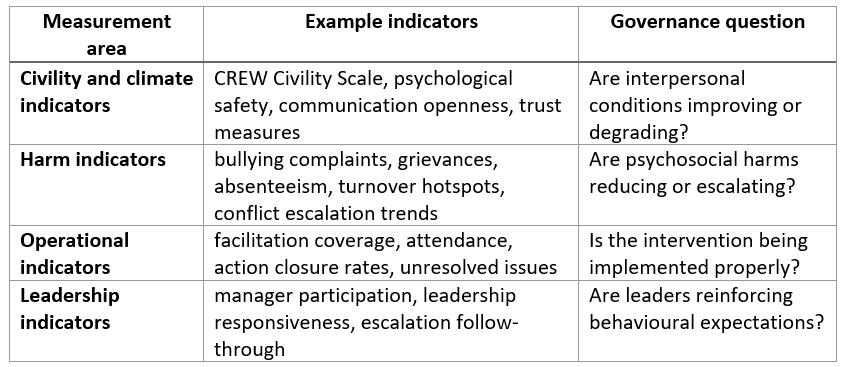
For CREW, the most defensible approach is a combined measurement model incorporating:
leading indicators;
lag indicators, and
process integrity indicators.
This creates a more balanced governance picture than relying on engagement scores alone.
The CREW Civility Scale is useful because evidence shows strong reliability and meaningful relationships with:
psychological distress;
workplace bullying;
supervisor support;
coworker support;
work engagement, and
intention to leave.
That makes civility measurable as a leading indicator rather than a vague cultural concept.
Importantly, organisations should avoid treating civility scores as “happiness metrics.” Civility matters because deteriorating interpersonal norms often predict broader psychosocial harm and organisational dysfunction.
Recommended measurement categories
Recommended reporting cadence
A practical reporting rhythm typically includes:
monthly operational dashboards for executives;
quarterly WHS board reporting with trend analysis;
six-month implementation reviews;
12-month outcome evaluations against baseline measures, and
periodic psychosocial risk reassessments.
Trend analysis matters more than isolated data points.
Boards should be looking for patterns such as:
whether incivility indicators are stabilising;
whether complaints are reducing or simply going underground;
whether psychological safety is improving;
whether managers are responding consistently, and
whether identified actions are actually being implemented.
If organisations cannot verify these things, then they are not truly managing psychosocial risk.
Conclusion
CREW is not a kindness campaign. It’s a practical psychosocial control aimed at the earliest stage of harmful behavior escalation: everyday incivility.
Australia’s WHS framework already treats harmful behaviors and psychosocial hazards as risk management obligations, and the cost profile of psychological injury claims has made this a governance priority.
CREW is one of the few interventions that can be run as a structured, measurable, workgroup-level control with clear leadership expectations, and it has a validated civility measurement tool that correlates with risk-relevant outcomes.
If you implement CREW like WHS—governed, resourced, measured, and embedded—it strengthens your psychosocial risk controls and your due diligence evidence. If you implement it like HR theatre, you will get exactly what you deserve: cynicism, disengagement, and a faster incivility spiral.
References
Comcare. (2019). Exercising due diligence: Guidance for officers. https://www.comcare.gov.au/about/forms-pubs/docs/pubs/safety/exercising-due-diligence-guidance-for-officers.pdf
Federal Occupational Health. (n.d.). CREW: Civility, Respect, and Engagement in the Workplace. U.S. Department of Health and Human Services. https://d38fsb1zpaztrx.cloudfront.net/files/Civility-Respect-and-Engagement-in-the-Workplace-CREW.pdf
Freedman, B., et al. (2024). The prevalence of incivility in hospitals and the effects of incivility on patient safety culture and outcomes: A systematic review and meta-analysis. https://researchonline.jcu.edu.au/82504/1/Freedman%20et%20al%202024The%20prevalence%20of%20incivility%20in%20hospitals%20and%20the%20effects%20of%20incivility.pdf
International Organization for Standardization. (2021). Mental health in the workplace (ISO 45003 overview). https://www.iso.org/news/ref2677.html
Maben, J., et al. (2023). Interventions to address unprofessional behaviours between staff in acute care: What works for whom and why? A realist review. BMJ Open. https://pmc.ncbi.nlm.nih.gov/articles/PMC10617100/
National Institute for Occupational Safety and Health. (2024, March 15). Healthy Work Design and Well-Being Program. Centers for Disease Control and Prevention. https://www.cdc.gov/niosh/research-programs/portfolio/hwd.html
Peng, X. (2023). Advancing Workplace Civility: A systematic review and meta-analysis of definitions, measurements, and associated factors. Frontiers in Psychology, 14, 1277188. https://doi.org/10.3389/fpsyg.2023.1277188
Safe Work Australia. (2022). Model Code of Practice: Managing psychosocial hazards at work. https://www.safeworkaustralia.gov.au/sites/default/files/2022-08/model_code_of_practice_-_managing_psychosocial_hazards_at_work_25082022_0.pdf
Safe Work Australia. (2024). Harmful Behaviours in the Workplace. https://www.safeworkaustralia.gov.au/sites/default/files/2024-07/d24_12653_harmful_behaviours_report_formatted_for_accessibility.pdf
Safe Work Australia. (2025, October 16). Key Work Health and Safety Statistics Australia 2025 (latest release). https://data.safeworkaustralia.gov.au/insights/key-whs-statistics-australia/latest-release
Safe Work Australia. (2018). Interpretive guideline: The health and safety duty of an officer under section 27. https://www.safeworkaustralia.gov.au/system/files/documents/1812/officer-duty-interpretive-guide.pdf
Safe Work Australia. (2020). Guide to the model Work Health and Safety Act. https://www.safeworkaustralia.gov.au/system/files/documents/2003/guide-to-the-model-whs-act.pdf
Standards Australia. (2023, July 4). New standards document to help manage workplace psychosocial risk. https://www.standards.org.au/news/new-standards-document-to-help-manage-workplace-psychosocial-risk
Tsuno, K., Shimazu, A., Osatuke, K., et al. (2022). Assessing workplace civility: Validity and 1-year test-retest reliability of a Japanese version of the CREW Civility Scale. Journal of Occupational Health, 64(1), e12332. https://doi.org/10.1002/1348-9585.12332
United States Department of Veterans Affairs. (n.d.). Civility, Respect, and Engagement in the Workplace (CREW). https://www.publichealth.va.gov/docs/employeehealth/55-CREW.pdf