
CARE: Primary Psychosocial Risk Controls When Resources Are Tight
Pre-Event Psychosocial Risk Management Framework 4

Introduction
Not every organisation has the budget for large wellbeing programs, external consultants, or new headcount.
But every organisation still has a legal duty to manage psychosocial risk.
Under Australian WHS law, employers must eliminate or minimise risks to psychological health so far as reasonably practicable. ISO 45003 reinforces this expectation by requiring leadership, hazard identification, control measures, and review within a structured safety management system.
Resource constraints are not an exemption.
The question is not “Can we afford to manage psychosocial risk?”
The question is “Are we designing work in ways that prevent harm?”
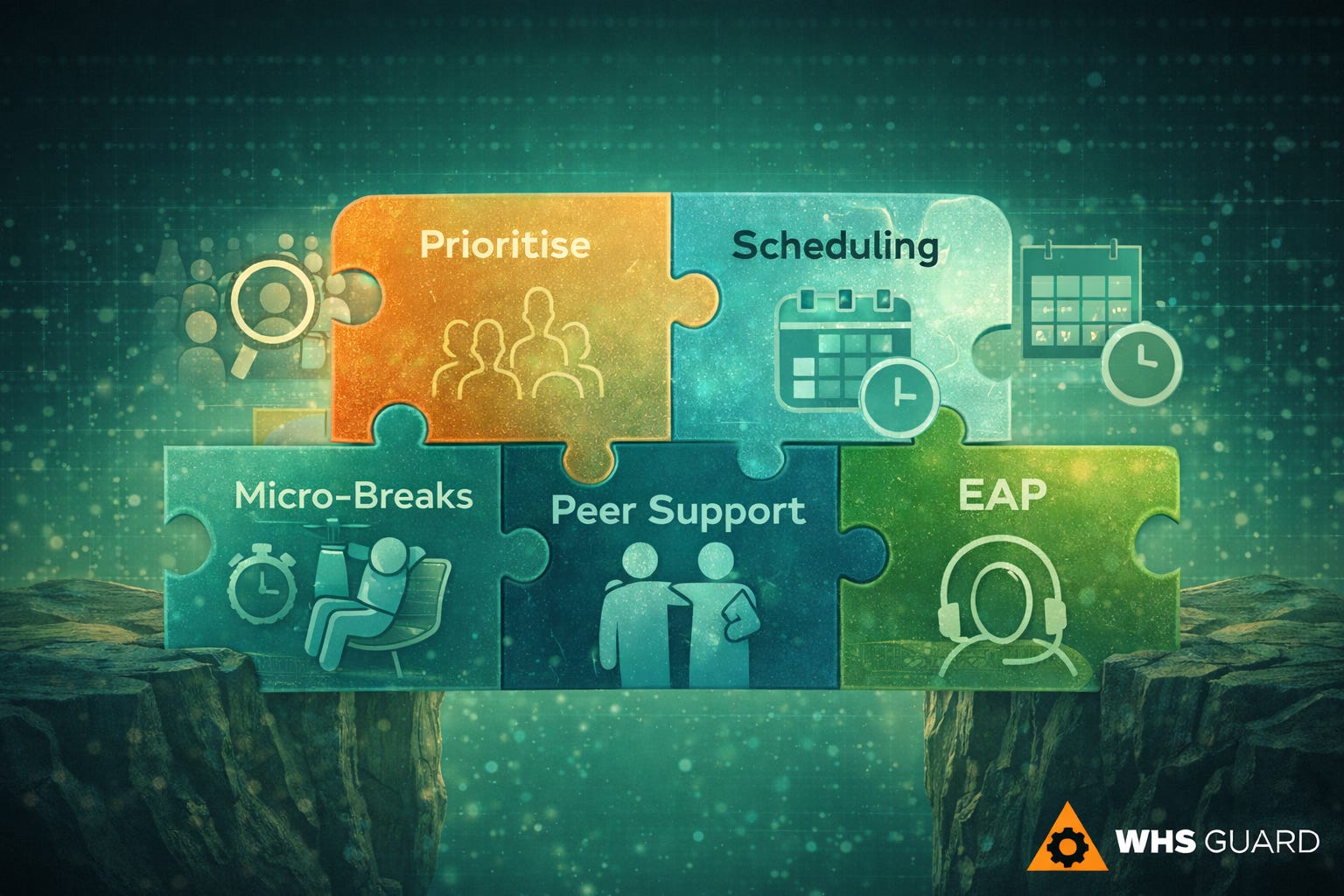
The CARE framework focuses on primary interventions that protect psychological health even when financial resources are limited. It prioritises practical, low-cost changes to work design, leadership behaviour, scheduling, and peer connection. These are not add-ons. They are core risk controls.
If RADAR is about detecting risk, and BRIDGE is about creating safety to speak up, CARE is about taking visible, affordable action.
The Logic of CARE
CARE stands for practical, evidence-informed actions that support mental health at the source of work design.
It is built on five principles:
Prioritise high-risk groups first;
Embed recovery into the workday;
Strengthen peer and social support;
Improve predictability and fairness in scheduling;
Optimise existing support systems before building new ones.
This is primary prevention. It addresses psychosocial hazards at their origin rather than relying only on individual coping strategies.
1. Prioritise High-Risk Groups
Resources are finite. Risk is not evenly distributed.
The first CARE step is to identify where distress, burnout, absenteeism, or turnover are clustering. Early warning dashboards, engagement surveys, and WHS data can highlight hotspots.
This aligns with ISO 45003’s requirement to identify psychosocial hazards and exposed groups before selecting controls.
Targeted support is more effective than broad, unfocused programs. A team experiencing workload pressure requires a different intervention than a team dealing with poor supervision or conflict.
Good governance asks:
Where is harm most likely?
Who is most exposed?
CARE begins there.
2. Micro-Breaks and Structured Recovery
Short, structured breaks during the workday are not indulgent. They are evidence-based controls.
A systematic review and meta-analysis of micro-breaks found that short breaks of up to 10 minutes significantly improve vigour and reduce fatigue across occupational groups¹. Micro-breaks interrupt prolonged cognitive or physical strain without reducing productivity².
Recovery mechanisms include stepping away from screens, stretching, breathing exercises, or brief task switching. These practices regulate stress responses and improve focus³ ⁴.
Importantly, micro-breaks cost nothing.
In knowledge work, organisations have successfully encouraged five-minute breaks every hour using simple reminders or mobile apps. After implementation, staff reported improved concentration and reduced fatigue, consistent with research findings¹.
Embedding recovery into the workday is a primary control. It reduces cumulative strain before it becomes burnout.
3. Peer-Support Networks
Peer-support programs are often low-cost and high-impact.
The RISE program at Johns Hopkins Hospital was developed after a clinician suicide. It provides 24/7 confidential peer support delivered by trained colleagues⁵. Staff can discuss distressing events without judgement and be referred to professional support when needed⁶.
The program has since been adopted by over 140 healthcare organisations globally⁵.
Peer support:
Reduces isolation;
Breaks stigma around emotional distress;
Decreases burnout risk;
Reduces reliance on formal leadership for emotional labour.
These programs do not require large budgets. They require structure, training, and leadership endorsement.
CARE recognises that social support is a protective factor against psychosocial harm. Organisations can cultivate it deliberately.
4. Flexible Scheduling and Workload Rotation
Predictability is a psychological stabiliser.
Gap Inc. trialled stable scheduling practices across 28 stores. The pilot introduced predictable shifts, additional staffing during peak periods, and voluntary shift swaps. The cost was approximately US $31,200. The outcome included a 5 percent productivity increase and 7 percent sales growth⁷.
Employees reported improved sleep and reduced stress.
The intervention demonstrates a core CARE principle: improving work design often improves performance as well.
Similarly, small businesses such as hairdressing salons have mitigated psychosocial strain by rotating tasks and allowing structured breaks, addressing repetitive and high-demand work patterns⁸.
Scheduling is not only an operational tool. It is a psychosocial risk control.
5. Foster Belonging and Social Connection
Belonging reduces burnout and turnover.
A U.S. emergency communications centre introduced weekly emails highlighting positive stories about dispatchers’ work. This simple initiative fostered pride and connection. Turnover decreased, saving approximately US $400,000 in recruitment and training costs⁹.
Kent State University introduced walk-and-talk sessions to normalise mental health conversations. Annual claims for depression reduced significantly, with measurable cost savings¹⁰ ¹¹.
Community-building initiatives:
Reduce stigma;
Increase engagement;
Reinforce meaning in work;
Strengthen retention.
These interventions are often cost-free. They require intention and leadership attention.
6. Optimise Existing EAP Systems
Many organisations already have Employee Assistance Programs.
However, utilisation is often low due to stigma, limited accessibility, or awareness gaps.
Kent State University expanded its EAP to include telehealth, 24/7 counselling, and mental health workshops. Positive survey responses tripled, and more than US $1 million in health claim savings were reported¹¹.
Before investing in new programs, CARE recommends optimising what already exists.
Accessibility, confidentiality, and visible leadership endorsement are often more important than adding new services.
Governance Alignment
CARE is not a wellbeing campaign.
It is a structured approach to fulfilling WHS obligations using primary controls.
Australian WHS law requires employers to eliminate or minimise risks so far as reasonably practicable. The hierarchy of control applies to psychosocial hazards as much as physical hazards⁸.
Primary controls such as work redesign, scheduling stability, recovery practices, and social support sit higher in the hierarchy than awareness posters or resilience training.
Boards and officers exercising due diligence must ensure:
Resources are allocated;
Systems exist to manage psychosocial risk;
Controls are implemented and reviewed;
Leaders are accountable.
CARE provides practical pathways to demonstrate that even limited-resource organisations are actively controlling psychosocial hazards.
Implementation Pathway
To embed CARE:
Start with data – Identify high-risk teams using PULSE dashboards, absenteeism, turnover, and survey feedback;
Engage leaders – Ensure senior managers model recovery behaviours and support participation;
Pilot low-cost interventions – Introduce micro-breaks, scheduling adjustments, or peer networks in targeted areas;
Measure impact – Track participation, morale, absenteeism, and turnover;
Adjust and scale – Refine interventions based on evidence and expand where effective.
CARE is iterative. It operates within the Plan-Do-Check-Act cycle of safety management.
Conclusion
Resource limitations do not remove responsibility.
The CARE framework demonstrates that organisations can implement meaningful primary psychosocial controls without large budgets.
Micro-breaks reduce fatigue. Peer networks reduce isolation. Stable scheduling reduces stress. Community initiatives reduce turnover. Optimised EAP systems improve access to care.
When integrated into governance systems and leadership accountability structures, these interventions strengthen compliance, performance, and psychological health.
CARE is about design, not decoration.
It ensures that psychosocial risk management is visible, practical, and defensible — even when resources are tight.
Footnotes
Kim, S., Park, Y., & Niu, Q. (2022). “Give me a break!” A systematic review and meta-analysis on the efficacy of micro-breaks for increasing well-being and performance. International Journal of Environmental Research and Public Health, 19(16), 9940. Available at: https://pmc.ncbi.nlm.nih.gov/articles/PMC9432722/
Ibid.
BHSI Clinics. (2023). Mental Health at Work | The Power of Taking Breaks. Available at: https://bhsiclinics.com/mental-health-at-work/
Ibid.
Edrees, H., et al. (2024). The RISE (Resilience in Stressful Events) Peer Support Program: Creating a Virtuous Cycle of Healthcare Leadership Support for Staff Resilience and Well-Being. Journal of Healthcare Leadership. Available at: https://pmc.ncbi.nlm.nih.gov/articles/PMC11639878/
Ibid.
U.S. Department of Health & Human Services. (2022). Workplace Well-Being Resources. Available at: https://www.hhs.gov/surgeongeneral/reports-and-publications/workplace-well-being/resources/index.html
WorkSafe WA. (2022). Psychosocial hazards in the workplace – Code of Practice. Available at: https://www.worksafe.wa.gov.au/sites/default/files/atoms/files/221154_cp_psychosocialhazards.pdf
U.S. Department of Health & Human Services. (2022). Workplace Well-Being Resources. Available at: https://www.hhs.gov/surgeongeneral/reports-and-publications/workplace-well-being/resources/index.html