
Are Solid-State Batteries?
What safety leaders need to understand before the hype outpaces governance.

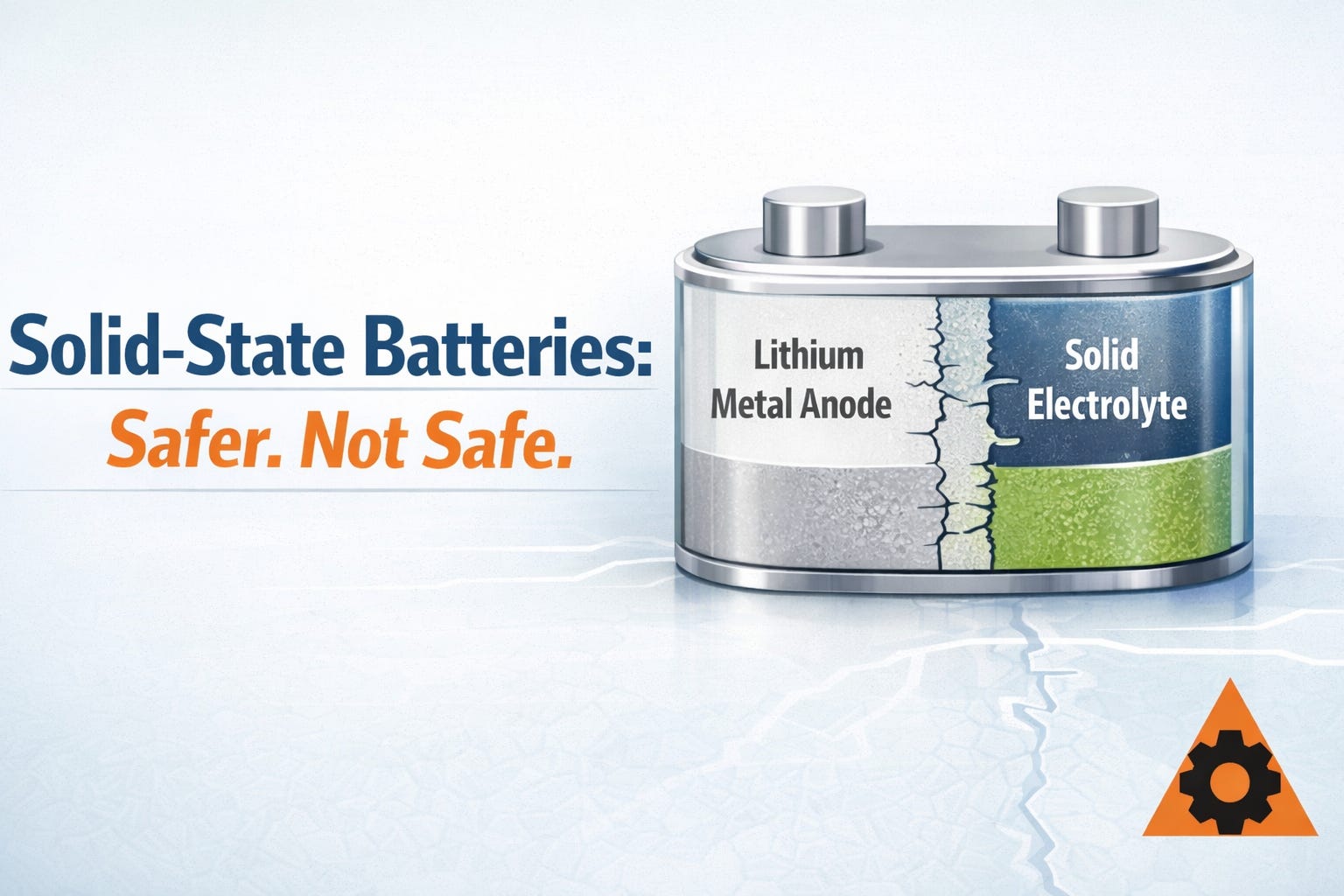
Solid state batteries are being promoted as safer future of energy storage.
Safer than lithium ion.
Safer for electric vehicles.
Safer for grid systems.
That framing is incomplete.
Yes, solid state batteries remove one major hazard: the flammable liquid electrolyte found in conventional lithium ion systems. That reduces ignition likelihood and lowers the probability of thermal runaway events that have plagued electric vehicles and battery energy storage systems.
But safety professionals know this already. Removing one hazard does not eliminate risk. It changes the risk profile.
Let’s break it down properly.
How It’s Different from a Lithium-Ion Battery
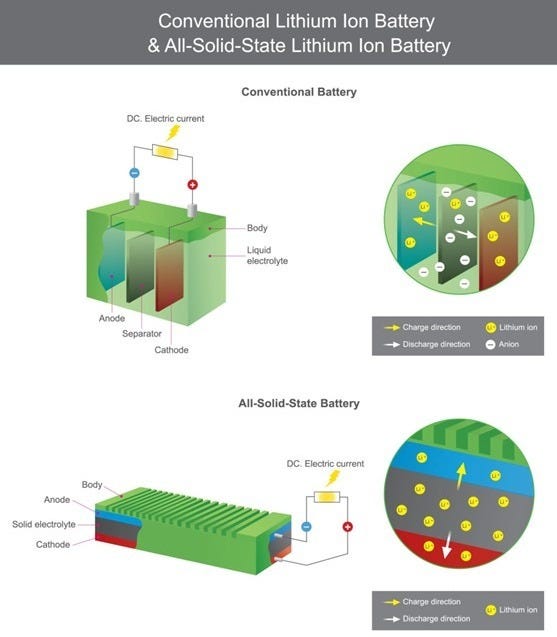
Conventional Lithium-Ion
Key components:
Anode (usually graphite)
Cathode (lithium metal oxide)
Liquid electrolyte
Separator
The liquid electrolyte allows lithium ions to move between anode and cathode during charge and discharge.
Problem: liquids are flammable and can degrade over time.
Solid-State Battery
Key difference:
The electrolyte is solid (ceramic, glass, or solid polymer).
Often paired with a lithium metal anode.
No flammable liquid.
More compact structure.
Potentially much higher energy density.
Why Everyone Is Talking About It
Solid-state batteries are seen as the next major step in energy storage, particularly for EVs. Companies actively investing in it include:
Toyota
QuantumScape
Samsung SDI
BMW
They are chasing four major advantages:
Higher Energy Density
More energy in the same space.
EV range could increase significantly without increasing battery size.
Improved Safety ?
No flammable liquid → reduced fire risk.
Thermal runaway risk is lower (not zero, but reduced).
Faster Charging Potential
Solid electrolytes may allow faster lithium ion transfer.
Longer Lifespan
Less chemical degradation over time (in theory).
The Reality Check
This is where the hype meets Chemistry.
Solid-state batteries still face major challenges:
Manufacturing complexity
Interface stability between solid layers
Dendrite formation (lithium spikes that can short circuit)
High cost
Scalability for mass production
As of 2026, most solid-state batteries are still in pilot or early commercial phases, not widespread deployment.
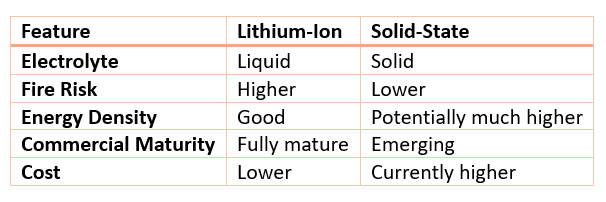
Simple Comparison
A. What Risk Is Actually Reduced?
Lower Flammability Risk
Conventional lithium-ion batteries use flammable liquid electrolytes.
When damaged, overcharged, or overheated, they can enter thermal runaway.
Solid-state batteries use a non-flammable solid electrolyte, typically ceramic or glass-based.
Impact:
• Reduced ignition probability
• Lower fire propagation risk
• Less volatile gas release
This is a genuine safety improvement. But lower is not zero.
B. What Risk Still Exists?
1. Electrical Energy Density Risk
Higher energy density means:
• More stored energy in smaller volume
• Greater consequence if failure occurs
These systems often use lithium metal anodes. Lithium metal is highly reactive. When exposed to moisture or damaged, it can ignite.
And energy density is increasing.
Higher energy density means more stored energy in less space. When failure occurs, the severity of consequence increases. From a risk formula perspective:
Risk equals likelihood multiplied by consequence.
If likelihood decreases but consequence increases, governance must tighten, not relax.
Even without flammable liquid, a short circuit can still cause:
• Rapid heat release
• Internal structural failure
• Explosion under confinement
If likelihood decreases but consequence increases, the overall risk equation does not magically improve.
2. Dendrite and Internal Failure Risk
One of the selling points of solid state technology is resistance to lithium dendrites. Dendrites are microscopic lithium spikes that grow during charge cycles and can pierce separators, causing internal short circuits.
Some solid electrolytes resist dendrite penetration better than liquid systems.
Some crack under stress.
Ceramic electrolytes are brittle. Mechanical vibration, thermal expansion mismatch or minor manufacturing defects can create micro fractures. Those fractures become pathways for internal shorts.
Internal shorts in high energy systems are not theoretical. They are catastrophic.
This is a new failure mode, not a solved one.
3. Manufacturing and Exposure Risks
The risk conversation often focuses on end users. It rarely looks upstream. Solid state battery manufacturing introduces:
• Fine ceramic powders introduce respiratory hazards
• Lithium metal handling introduces reactivity risks
• High temperature processes increase industrial exposure profiles
During installation and use:
• High voltage hazards remain
• Energy density increases consequence severity
• Storage and transport protocols must adapt
Workplace health risks change. Control measures must evolve. Respiratory protection, dust management, chemical controls and explosion protection standards need updating for this new supply chain. Governance must follow material science.
4. Mechanical and Lifecycle Risks
Solid electrolytes are often brittle ceramics.
Mechanical stress from:
• Vibration
• Impact
• Thermal expansion mismatch
This can cause micro-fractures.
Micro-fractures compromise:
• Ion transport
• Structural integrity
• Internal isolation
This becomes a design risk and a lifecycle monitoring issue, not just a chemistry problem.
5. Disposal Uncertainty
We understand lithium ion degradation pathways reasonably well. Solid state battery end of life behaviour is less mature.
Questions remain:
• How do solid electrolytes degrade under real world cycling?
• What happens if lithium metal becomes exposed during recycling?
• Are current waste transport classifications sufficient?
Regulatory frameworks often lag innovation. That creates blind spots.
Boards should be asking: are we adopting a technology faster than our control systems can adapt?
The Strategic Safety Reality
Solid-state batteries are safer in one dimension.
They are more complex in others.
Risk still equals likelihood multiplied by consequence.
If ignition likelihood drops but stored energy increases, control systems must evolve accordingly.
New chemistry.
New failure modes.
The conversation should not be “Are solid state batteries safer?”
It should be: How does the hazard profile shift, and are our controls aligned to that shift?